
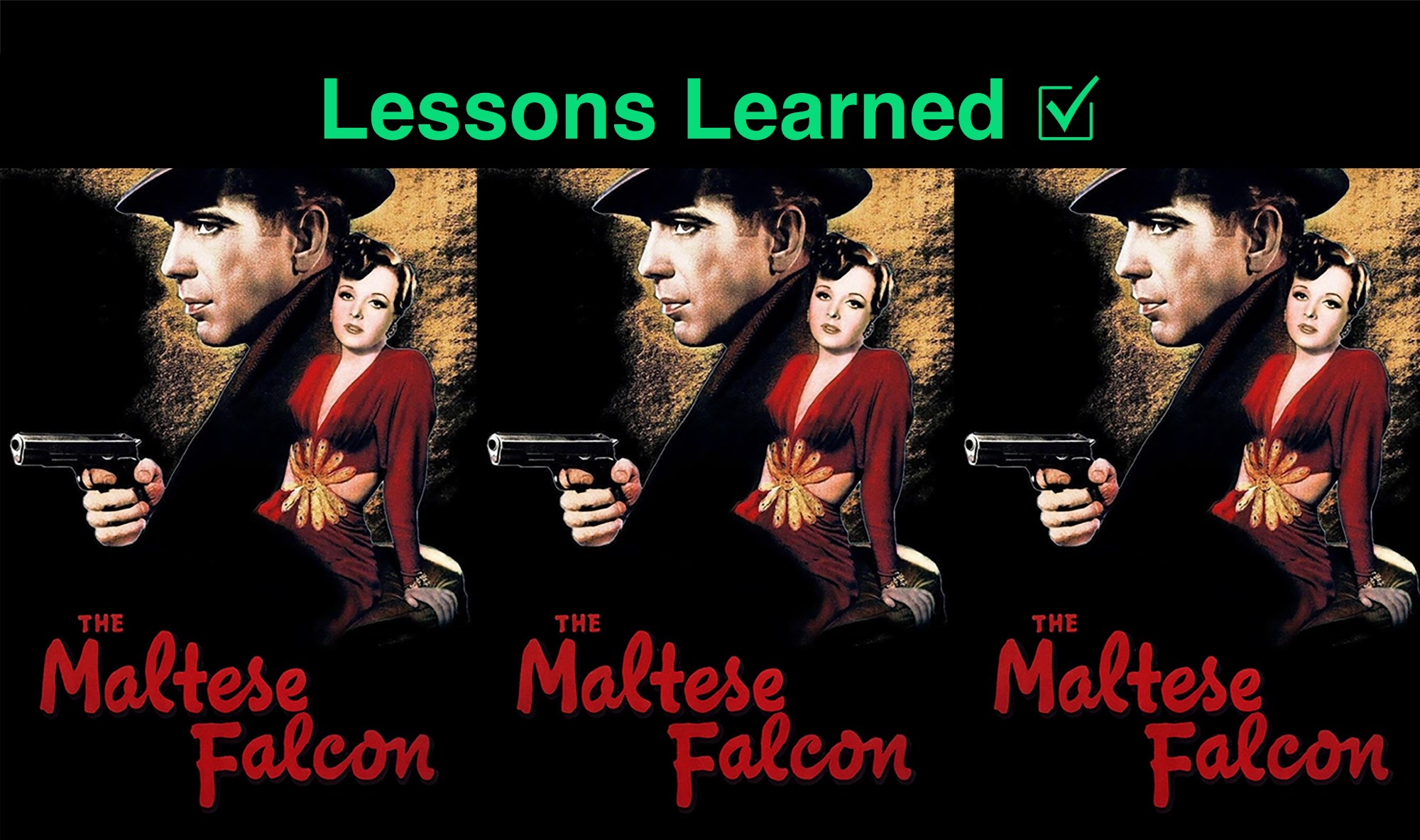
San Francisco private detective Sam Spade takes on a case that involves him with three eccentric criminals, a gorgeous liar, and their quest for a priceless statuette, with the stakes rising after his partner is murdered.
The Maltese Falcon is a film noir classic released in 1941, based on the novel by Dashiell Hammett, and written and directed by John Huston.
Here are three lessons I learned from reading The Maltese Falcon screenplay:
#1. HAVE OTHER CHARACTERS LABEL YOUR PROTAGONIST FOR THE AUDIENCE
On the following page of The Maltese Falcon, our protagonist is labeled in numerous ways:
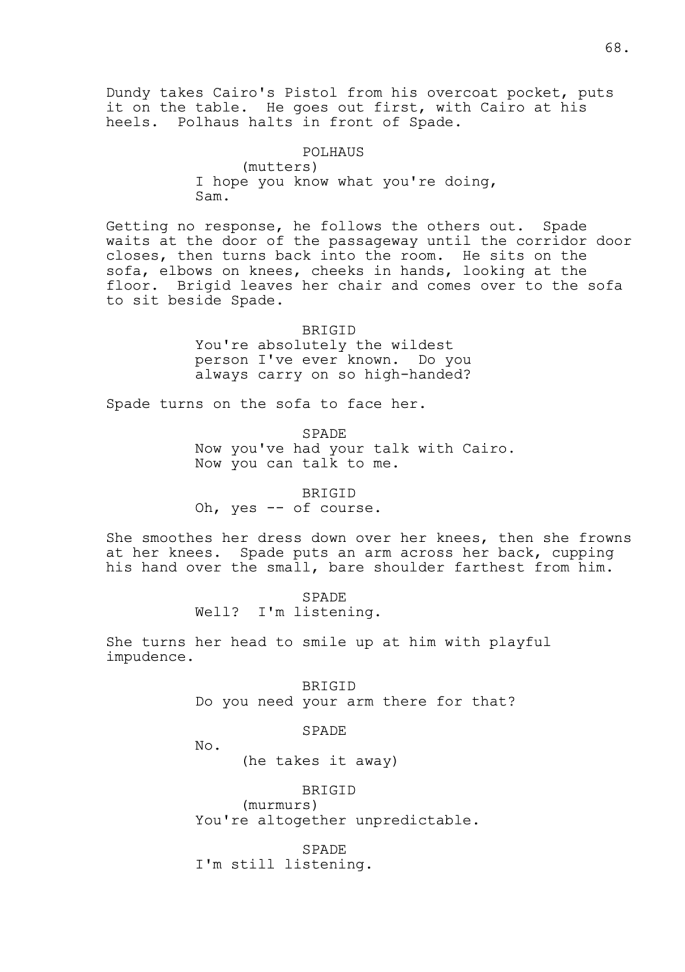
Brigid tells Samuel Spade, “You’re absolutely the wildest person I’ve ever known. Do you always carry on so high-handed?” She’s telling us exactly who Spade is, then immediately making us wonder what he’ll do next. Spade ignores the question and uses physicality to take control of the moment.
Later, Brigid murmurs, “You’re altogether unpredictable.” If Spade were predictable, the story would likely be far less interesting. His choices are active and unpredictable. That’s what keeps the story moving.
#2. HOW TO WRITE ASSERTIVE POLITENESS
On the following page of The Maltese Falcon screenplay, Spade has a phone conversation revealing his personality in subtle ways, then takes a limousine to Brigid’s apartment:
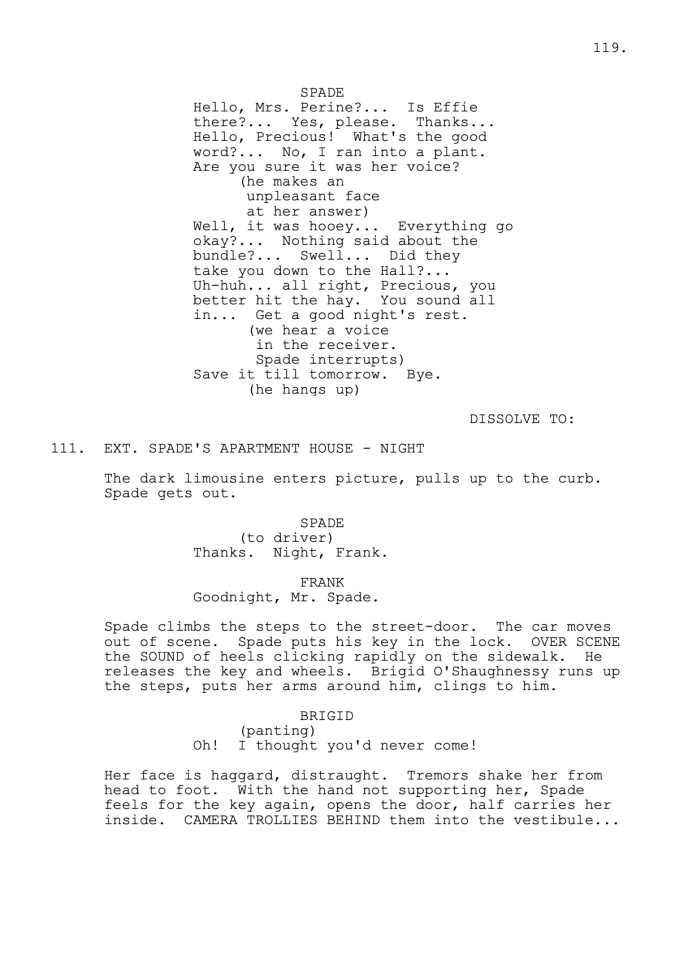
There’s a fine line between assertive and rude, and Spade walks it perfectly. In the phone call on the page above, he calls Effie “Precious”, asks questions like “What’s the good word?” and “Everything go okay?” and then tells her to get a good night’s rest. When she (presumably) attempts to continue the conversation, he says, “Save it till tomorrow. Bye.” and hangs up.
The difference is empathy. Spade toes this line throughout the script, later using moments of violence, but almost all of his interactions are polite in their alpha intensity. He is in control and we know it, yet this does not mean he needs to bully or put others down.
That balance makes him someone you want to follow.
#3. HAVE CHARACTERS TEST EACH OTHER
On the following page of The Maltese Falcon screenplay, Spade calls out Gutman for “palming” one of the bills:
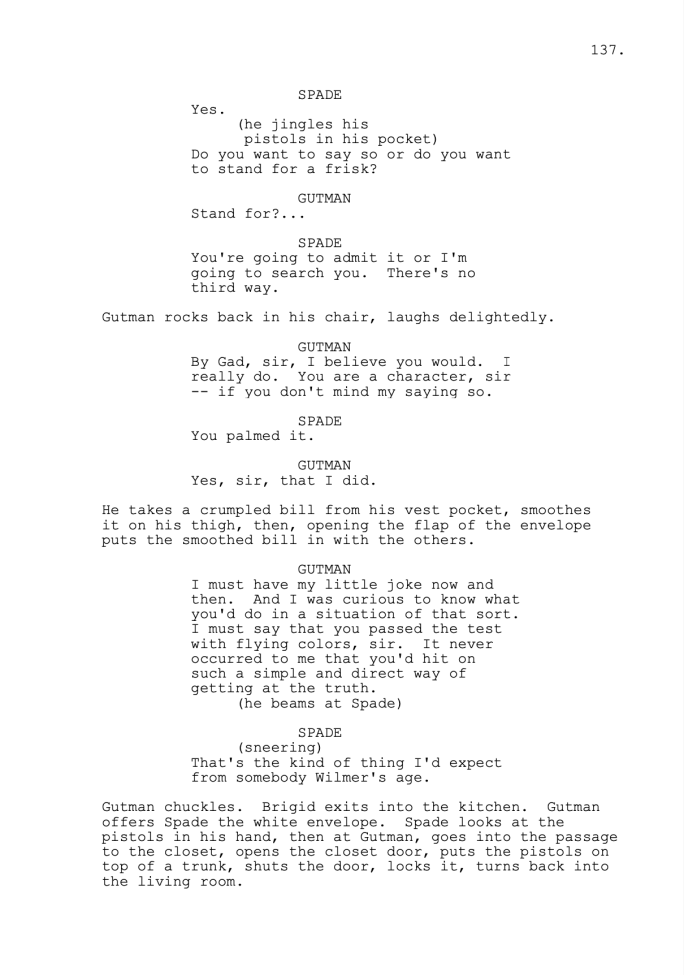
Whether or not Gutman is testing him, Spade’s response tells us everything. We start to admire how he reads situations and stays in control. Once again, he is polite yet firm. It could’ve been insulting, but Spade stays in control.
On the page above, we see that Gutman is sly and untrustworthy, and we see that Spade is an exceptional detective who knows how to handle shifty low-lifes. Huston slowly shifts who we’re rooting for through simple action and reaction.
On a technical level, the script still carries some of its novelistic roots. Longer sentences. Detailed descriptions. But everything is stripped down to what matters. Huston balances it well.


