

A student at Oxford University finds himself drawn into the world of a charming and aristocratic classmate, who invites him to his eccentric family’s sprawling estate for a summer never to be forgotten.
**spoilers**
Saltburn is Emerald Fennell’s follow-up to her Academy Award-winning screenplay, Promising Young Woman. Fennell once again finds ways to surprise the audience through sharp character choices and carefully controlled reveals. During a Q&A, Fennell described Saltburn as “a modern vampire movie without vampires.” She talked about how the gothic tone, the production design, the costumes, everything was filtered through that idea.
Here are three lessons learned from reading the Saltburn screenplay:
#1. PLAY WITH THE AUDIENCE
On the following page of the Saltburn screenplay, Oliver, an outcast at a new school, attempts to buy a round of drinks for his new friends. He tells the barman he can’t afford it, and Felix comes to the rescue:
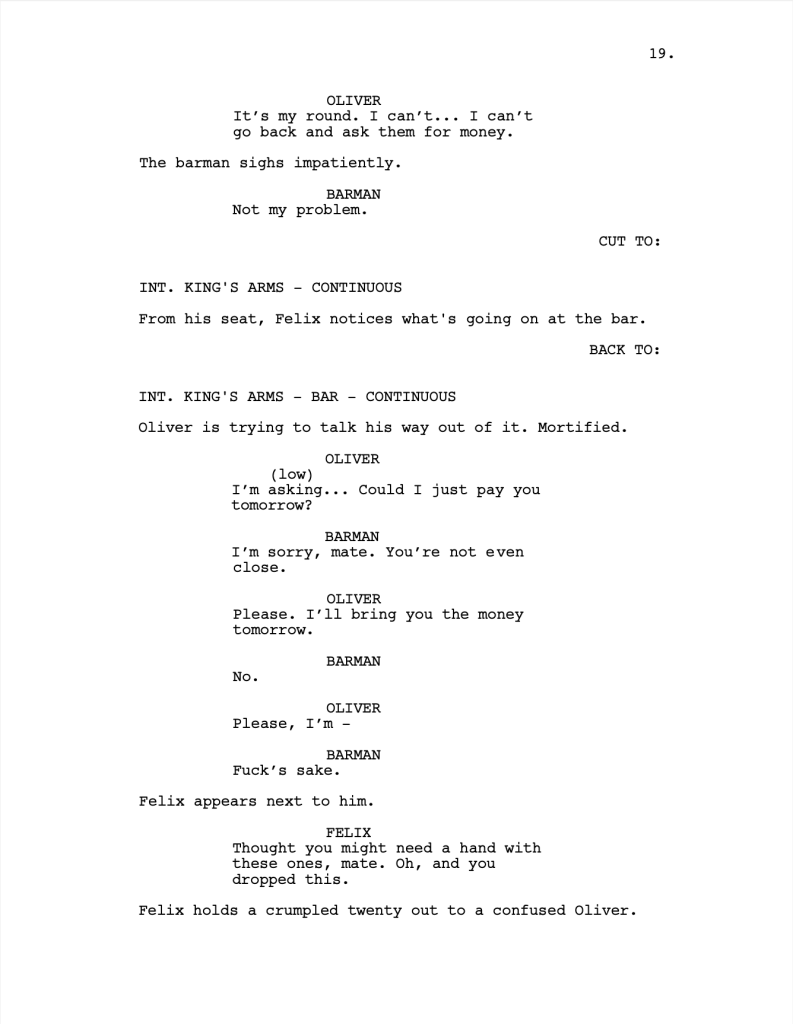
Naturally, we believe Oliver and see Felix as genuinely kind. It plays as a genuine moment of connection between them. It isn’t until the end of the film that this scene is revisited in flashback, revealing that Oliver had plenty of money and pretended to be poor so that Felix would take pity on him.
Moments like this caught me off guard and made me trust the storytelling even more. What I took away was to play with the audience in unique ways, through withholding information, delayed reveals, or using intimacy as a form of control (Oliver uses sex as a weapon throughout the film, which is hardly surprising when you look at Fennell’s previous film).
The story assembles itself piece by piece, and you don’t realize how much you’ve been misled until it’s too late.
#2. GIVE YOUR CHARACTERS DARK SECRETS
The following page shows Oliver’s lies coming to light:

Oliver lied about his own father’s death as a way to gain sympathy and further the friendship. Felix has no idea. He thinks he’s taking Oliver home to surprise him on his birthday and help him reconnect with his mother. The tension when Felix meets Oliver’s “horrible” parents is immediate.
Everyone in this film is hiding something, and each reveal pulls you in further.
I will admit, as I watched Saltburn, I had no idea what was going to happen. As someone who studies storytelling and writes every day, that rarely happens. It was exciting. Fennell doles out secrets with precision, whether it be through gossip (there’s a lot of it at Saltburn), through Oliver’s perspective as he watches people from afar, or through characters being caught in their lies (like the scene above).
#3. HOW TO EFFECTIVELY WRITE FLASHBACKS AND VOICE OVERS
Another page from the Saltburn screenplay:

Fennell uses flashbacks to great effect, mainly at the beginning and end of the film. The voiceovers are used heavily in these sections, then appear only sparingly throughout. We’re pulled into the head of an unreliable narrator because of how carefully information is withheld. By not showing Oliver’s family or home life, we believe his lies to Felix. And Oliver’s obsession is clear from the beginning.
Instead, we see POV shots of Felix and hear voiceovers of Oliver talking about him. In the beginning, I liked the character, and because of the way it’s framed, we don’t have a sense of his darkness just yet. When the film finally reveals who he’s been talking to, a dying Elspeth, everything shifts. We’re seeing the same man in the same room, but now he feels like a snake. A murderer. And his voiceovers elicit fear.


