

“Imprisoned on the planet Sakaar, Thor must race against time to return to Asgard and stop Ragnarök, the destruction of his world, at the hands of the powerful and ruthless villain Hela.”
Fun. That’s the word that comes to mind with Thor: Ragnarok.
Following the first two Thor films, this one takes a sharp turn in tone. That shift starts on the page. Written by Eric Pearson, Craig Kyle, and Christopher L. Yost, this is one of the easiest screenplays to read. It moves fast. It’s light. It knows exactly what it is.
Here are three lessons learned from reading the Thor: Ragnarok screenplay:
#1. INTRODUCE CHARACTER REVEALS WITH CLARITY
In the following scene, “Scrapper #142” is revealed to be Valkyrie:
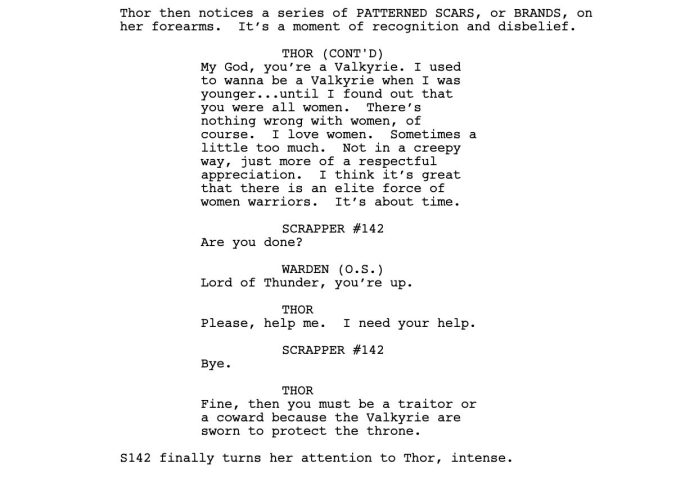
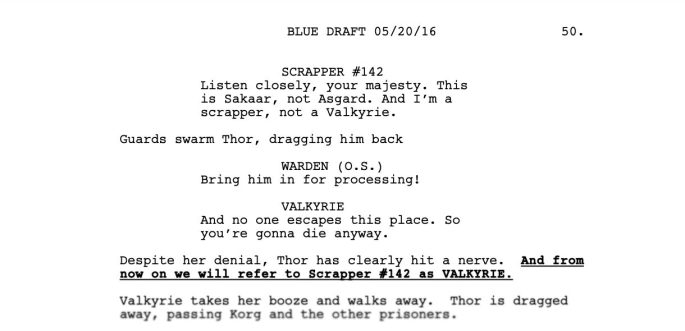
Prior to this moment, she is only known as Scrapper #142. Once her identity is revealed, the script makes a clean shift and refers to her as Valkyrie moving forward. It’s simple, but effective.
In other scripts, name changes can be handled more subtly, but here the clarity fits the tone. This is a fast-moving story. The audience does not have time to question who someone is. As the character becomes more important and more of her past is revealed, the name change reflects that shift. We are getting closer to her, so the script becomes more direct.
#2. USE HUMOR TO DELIVER EXPOSITION
In the following scene, Thor speaks with Korg about losing his hammer:
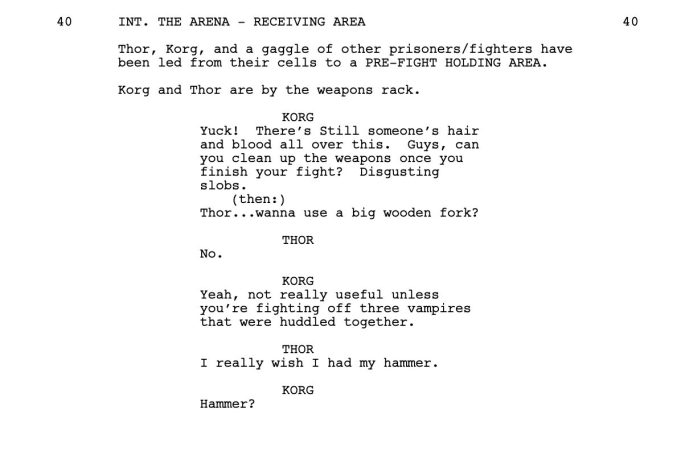
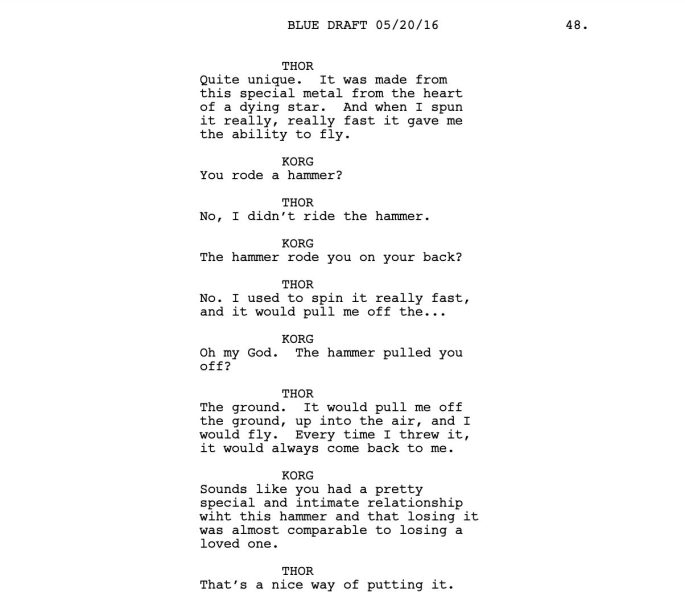
The scene is funny. It lands. But it is also doing something important. Thor losing his hammer is a major emotional beat. Instead of explaining that directly, the script lets the humor lead. Once the laugh hits, Korg reframes the loss in a way that makes the emotional weight clear.
“Sounds like you had a pretty special and intimate relationship with this hammer… almost like losing a loved one.”
Without that line, the loss might feel surface-level. With it, we understand what the hammer meant to Thor.
The humor opens the door. The exposition walks through it.
#3. SLOW DOWN WHEN IT MATTERS
At a key moment, the script cuts away from the action as Thor speaks with Odin:
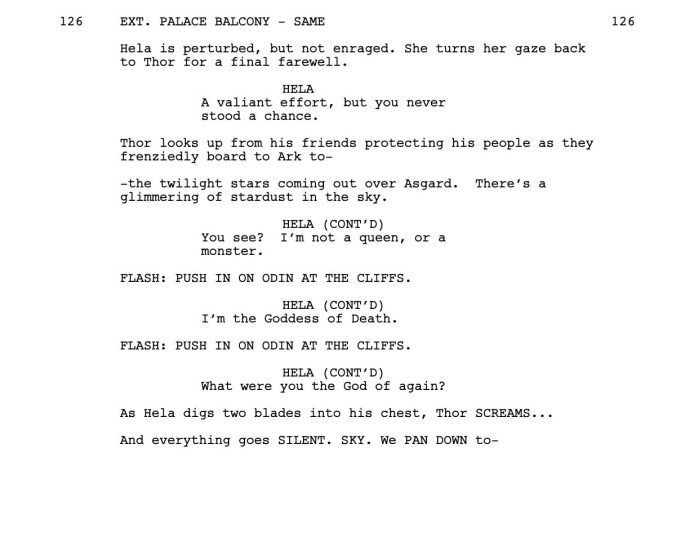
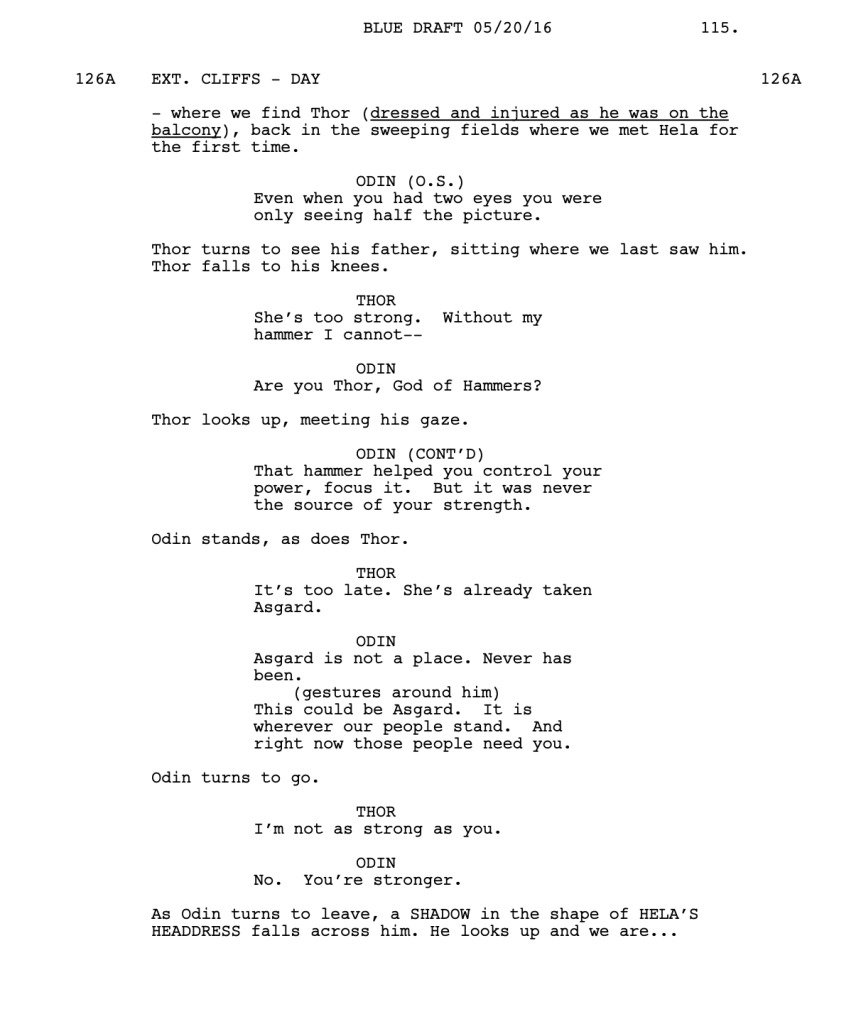
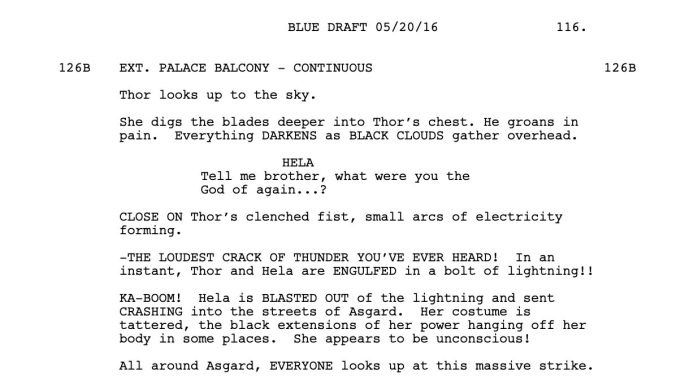
This is a high-energy film. Most of it moves quickly. So when it slows down, it stands out. Thor has just lost everything. His hammer is gone. He is being overpowered. Then the script cuts to a quiet moment with his father. From a technical standpoint, the transition is simple. The script uses “FLASH” to move between moments. No over-explanation. Just a clear shift. The scene is short, but it resets him. His perspective changes. His energy changes. When the story returns to the action, he is not the same. Less, used at the right time, does more.
The Thor: Ragnarok screenplay is lean and efficient. It uses humor, clarity, and restraint to carry a story that could easily become overwhelming.
It’s a reminder that tone, pacing, and simplicity do a lot of heavy lifting.


