
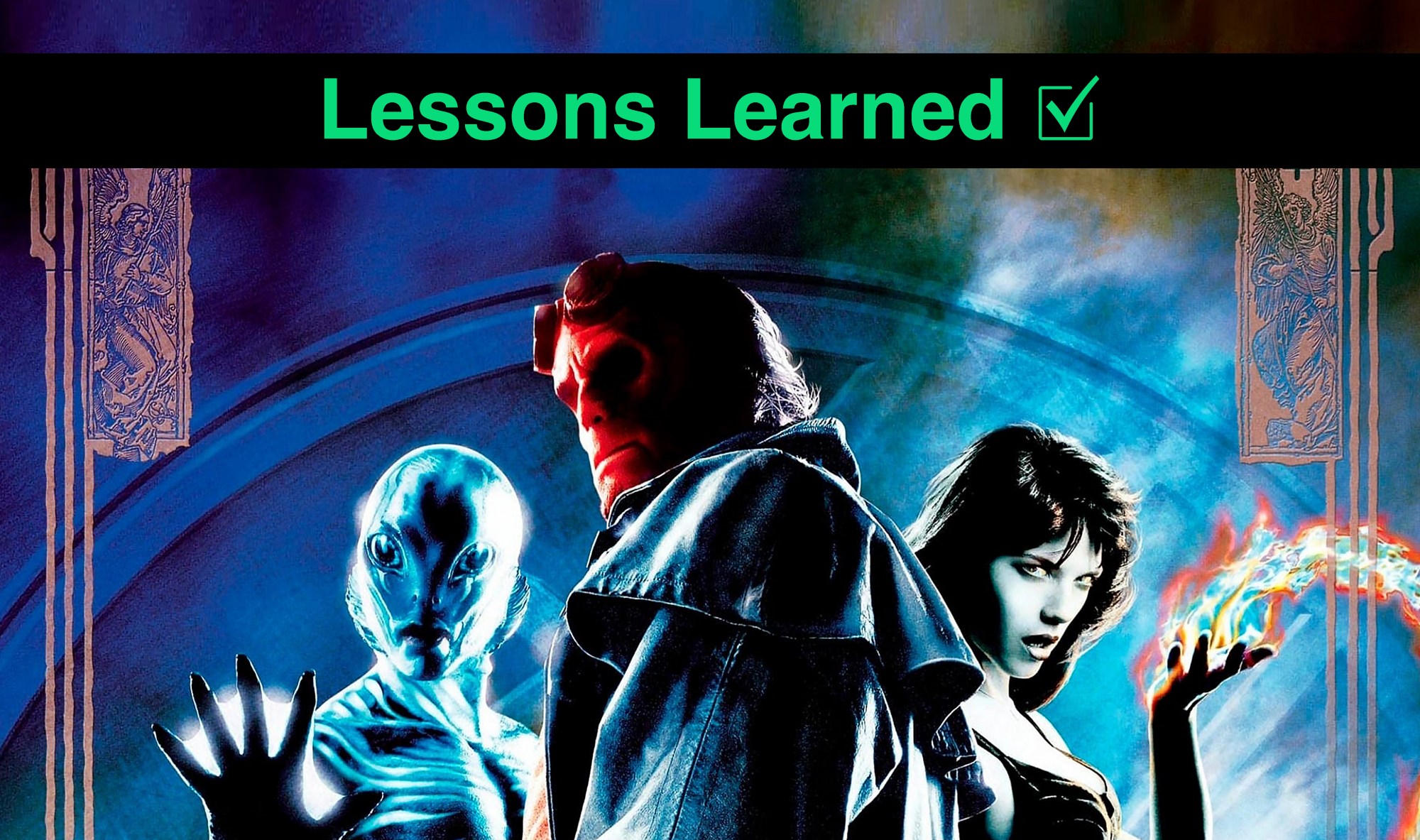
“A demon, raised from infancy after being conjured by and rescued from the Nazis, grows up to become a defender against the forces of darkness.“
It took many years for writer/director Guillermo Del Toro to get his adaptation of DC Comics’ Hellboy to the big screen. The lovable antihero is brought to life by actor Ron Perlman, and the story continues in the sequel Hellboy: The Golden Army.
Here are three lessons learned from reading the Hellboy screenplay:
#1. INTERTWINE TECHNOLOGY AND MAGIC
On the following page of the Hellboy screenplay, the villains attempt to open a portal:
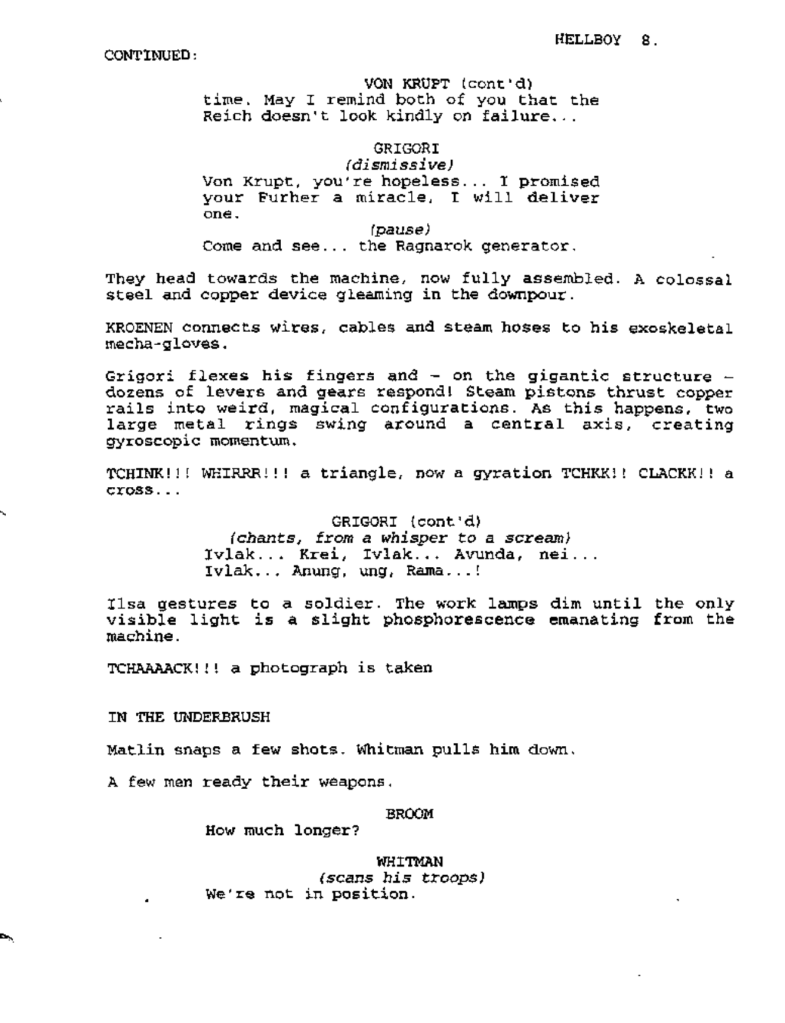
Technology and magic are woven throughout the Hellboy screenplay. On the page above, “two large metal rings swing around a central axis, creating gyroscopic momentum,” opening a portal revealing an alien galaxy sparkling on the other side. From the very beginning, these science-based fantastical elements are essential to the Hellboy plot.
Later, Abe Sapiens is introduced as “A fish-man. Slender, dolphin-gray, but with a dark pattern streaking his soft skin. Bright blue eyes shining with sharp intelligence above a thin wound-like mouth. Gills bubbling.” That is an exceptional introduction. Abe Sapiens, played by pitch-perfect Doug Jones, uses high-tech gadgets throughout the film, in one case in conjunction with his otherworldly senses to locate creature eggs.
The fantasy elements are entertaining on their own, but they’re also doing story work.
#2. REVEAL MYTHOLOGY THROUGH CHARACTER
In this section, Abe removes eggs implanted in Hellboy’s arm after a fight:
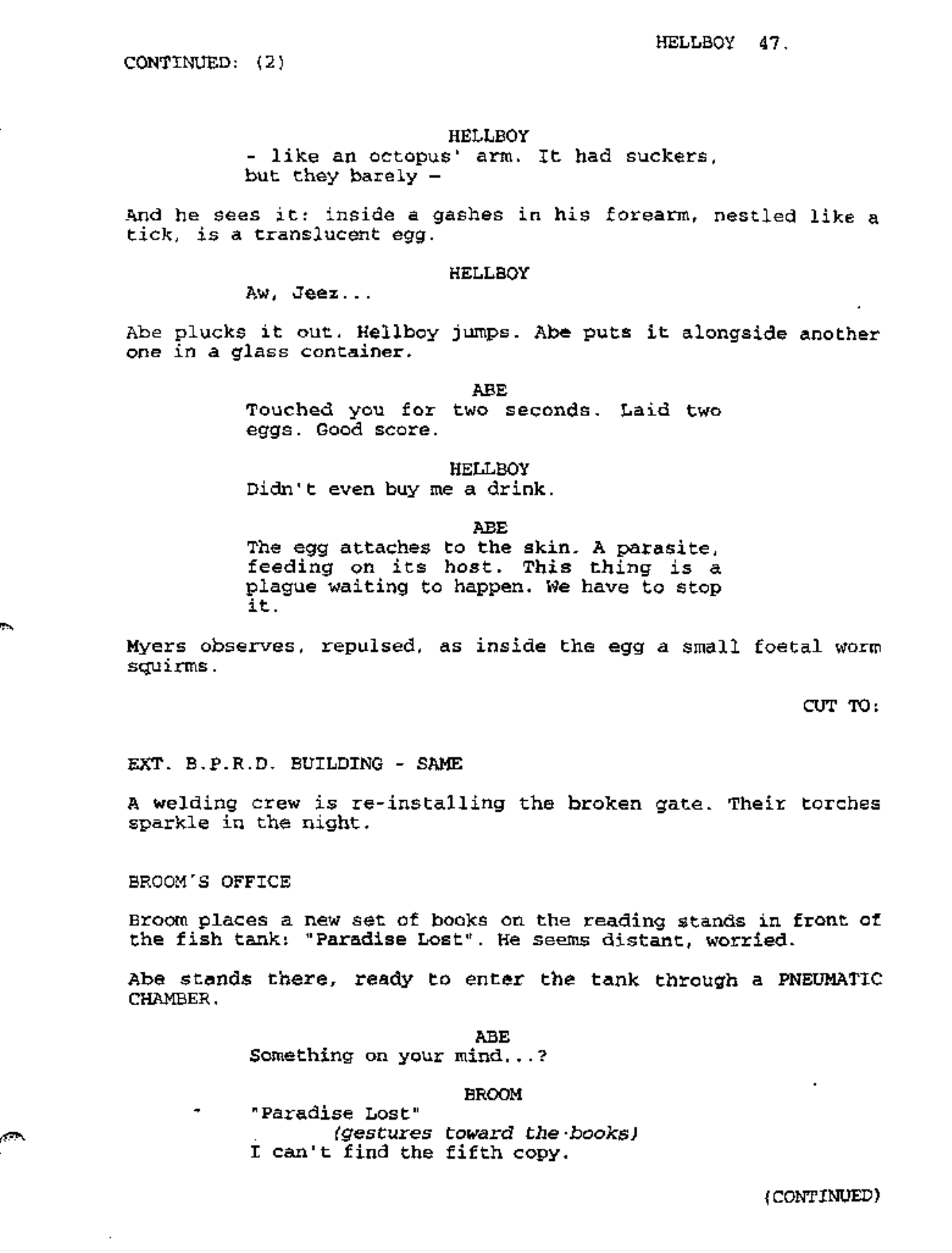
The above page is one of the many examples of how Guillermo establishes mythology in organic, humorous ways. With Abe plucking eggs from a gash on Hellboy’s arm, we learn the parasitic nature of the creature they’re up against, which is dark and horrific. The back-and-forth humor between Hellboy and Abe lightens the tone. Hellboy slips in a joke and then Abe immediately shifts back to the problem at hand: “We have to stop it.”
There is A LOT of mythology being established in 115 pages…from seemingly immortal Nazis to portals, demons, fish creatures, and Hellboy’s love interest Liz (portrayed beautifully by Selma Blair) who struggles to control the fire inside her. Guillermo takes his time establishing these characters and their abilities, but never at the expense of personality. Everyone wants something. Reading the script reminded me that mythology works best when it’s revealed gradually, through character, conflict, or humor.
The mythology is dense, but it never feels dense.
#3. BALANCE HEAVY DIALOGUE WITH VISUAL STORYTELLING
Here, Agent Myers convinces Liz to come to the Bureau, then we cut to Hellboy investigating tunnels:
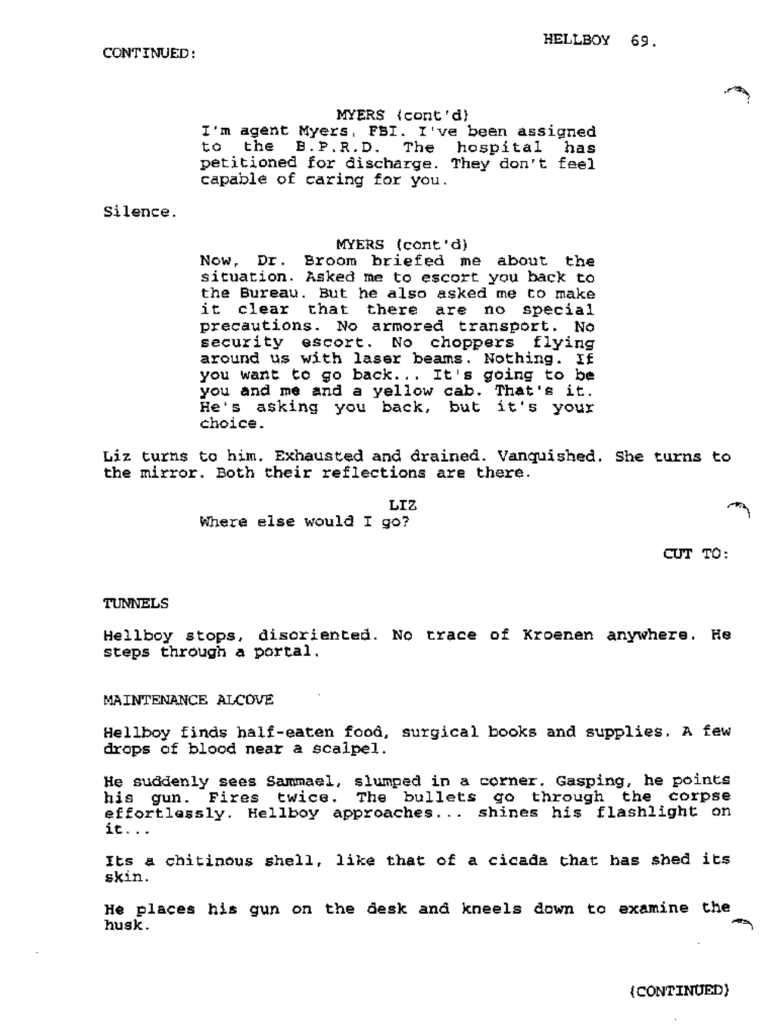
The interaction between Myers and Liz is dialogue heavy, but Liz says a lot with very little. It is less action-oriented, and more about driving the story forward. Scenes like this are important, with characters trying to change each other’s minds. But too many conversations in a row can dull momentum. Film tends to demand a different balance. Audiences are watching images, not just listening to information.
Guillermo Del Toro is an expert at explaining things visually, balancing the dialogue with moments like the one that follows on the page above. Hellboy fires at a figure in the darkness and discovers it’s only a husk. The story keeps moving. Questions multiply. The mystery deepens.


