
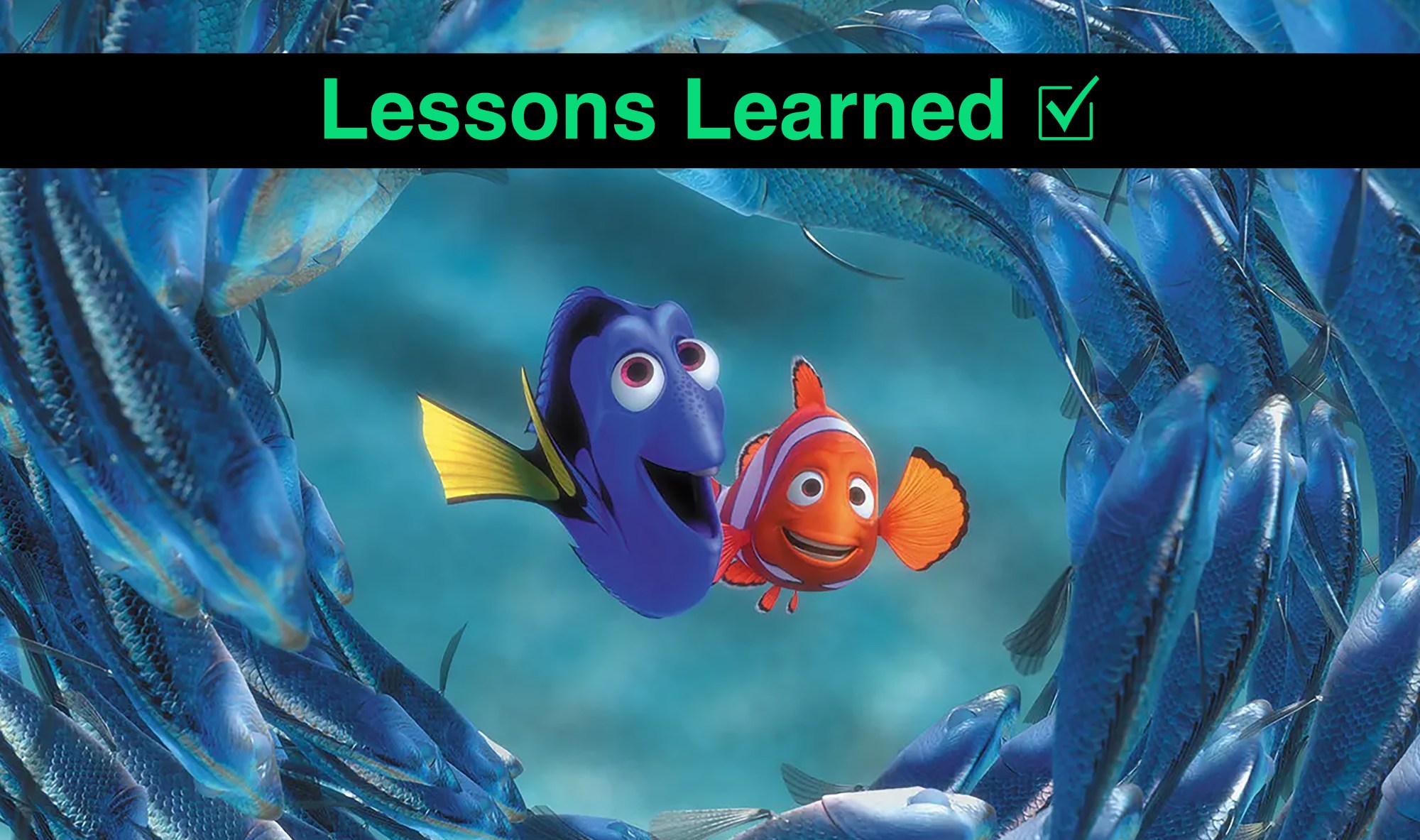
“After his son is captured in the Great Barrier Reef and taken to Sydney, a timid clownfish sets out on a journey to bring him home.”
Finding Nemo felt like it took over the world when it came out in 2003. After reading the screenplay by Andrew Stanton, Bob Peterson, and David Reynolds, it’s easy to see why. It’s simple on the surface, but everything is doing something.
Here are three lessons I learned from reading the Finding Nemo screenplay:
#1. CRAFT DISTINCT CHARACTER QUIRKS AND USE THEM
On the following page of the Finding Nemo screenplay, Marlin finally gets fed up with Dory and comes to a realization:
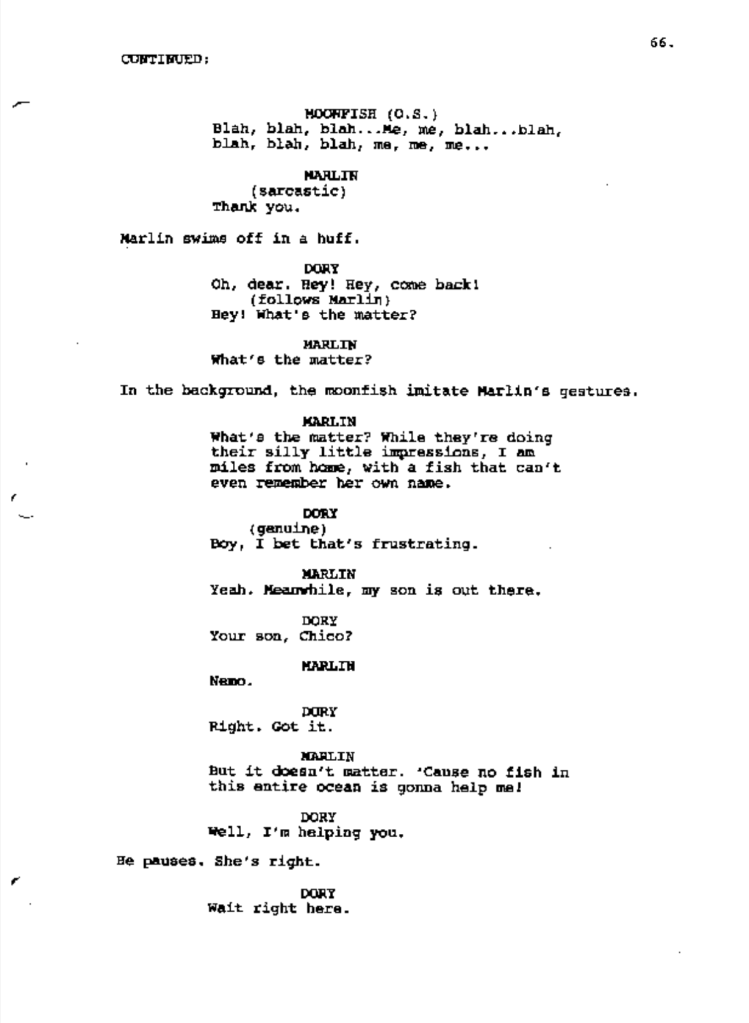
It’s chaotic. It’s funny. It’s also doing real character work. Dory’s short-term memory loss is one of the most recognizable traits in the film. On its own, it’s a joke. But paired with Marlin’s fear and frustration, it becomes something more. He snaps. He insists no one is helping him. While she’s right there.
The contradiction feels real. People do that. They panic, they spiral, they ignore the person standing next to them. Then the scene pushes further. The moonfish copy him. His frustration gets mirrored back at him in a way that’s ridiculous and a little uncomfortable.
The quirk isn’t just decoration. It drives the moment. It creates pressure, then releases it.
#2. GIVE THE CHARACTER A FEAR WORTH OVERCOMING
In the following scene, Marlin tells his story, and it starts to spread:
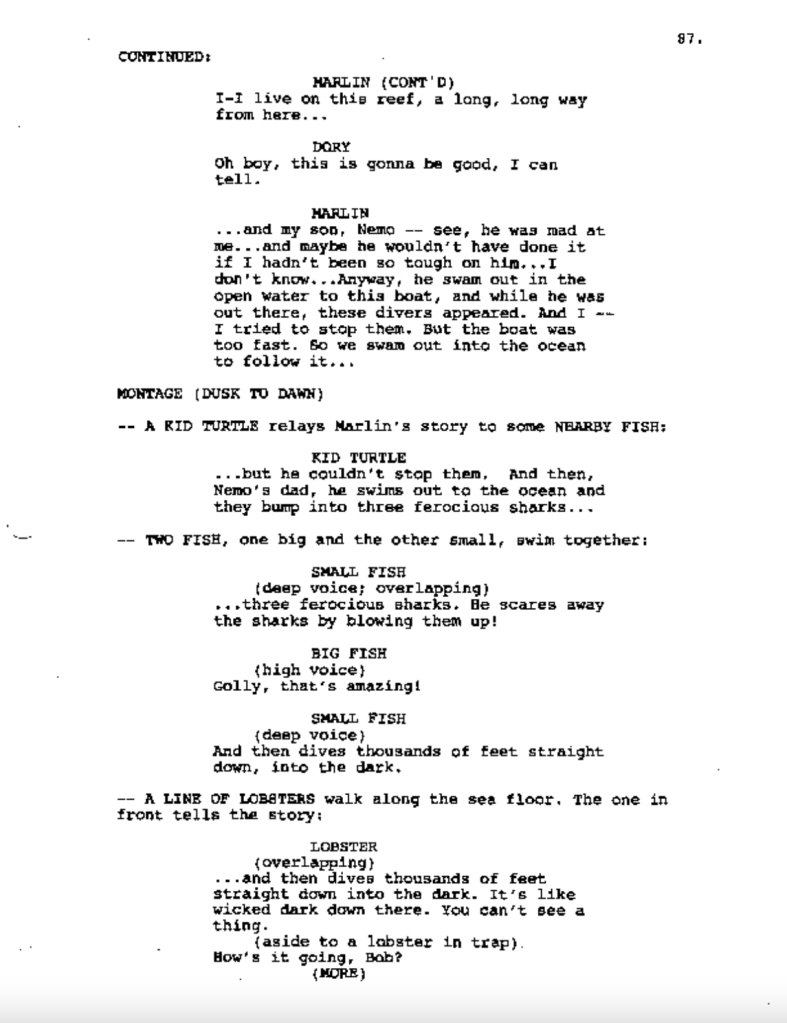
At first, it’s uneven. Marlin is trying to explain what happened, but it comes out in pieces. Hesitation. Second-guessing. He’s still inside it. Then it moves. A turtle repeats it. Then two fish. Then a lobster. Each version shifts slightly, but the core holds. The story starts to travel farther than he has. And somewhere in that, the way he’s seen begins to shift. He’s not just the overprotective father anymore. He’s the one who left the reef. The one who kept going.
At the beginning, everything about him is built around avoiding risk. Stay close. Stay safe. Don’t go out there. Then the situation forces the opposite. Open water. No control. No guarantees. The story spreads the same way his world opens up. Slowly, then all at once. By the time it reaches other creatures, it carries weight he doesn’t fully recognize yet.
#3. PLAY WITH YOUR WORLD
In the following sequence, Dory tries to speak whale while Marlin argues with her, and things escalate quickly:
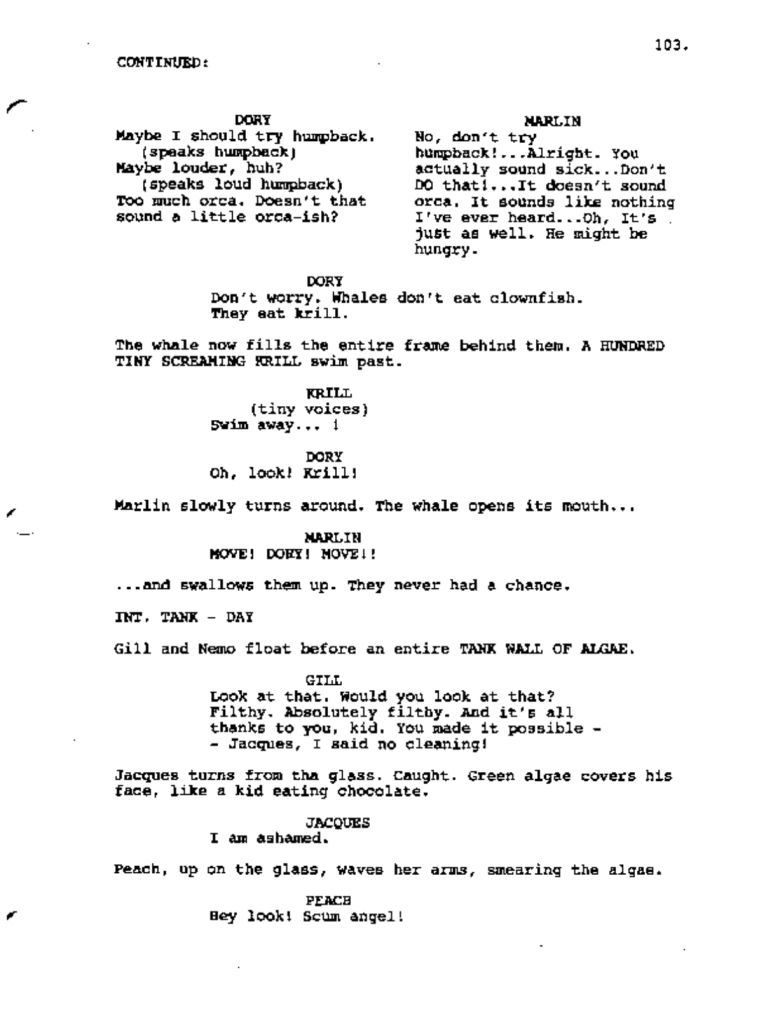
It shouldn’t work. She’s speaking whale. He’s yelling. The situation is escalating in the most ridiculous way possible. And it still holds tension. The scene keeps shifting. Funny, then uneasy, then funny again. It doesn’t settle in one place for long. The script leans into the world instead of pulling back from it.
Then it cuts to the tank. A different environment, different energy, but the same sense of play. Jacques gets caught cleaning and says, “I am ashamed.” Peach smears the glass. “Hey look! Scum angel!” Small moments, but specific. The kind of details that make the world feel lived in. Every setting has its own rhythm. Its own way of being funny. Its own way of moving the story forward.
Finding Nemo keeps everything clear. The characters are defined. The fear is simple. The world stays playful without losing focus. It doesn’t try to do more than it needs to. It just does it well.


