
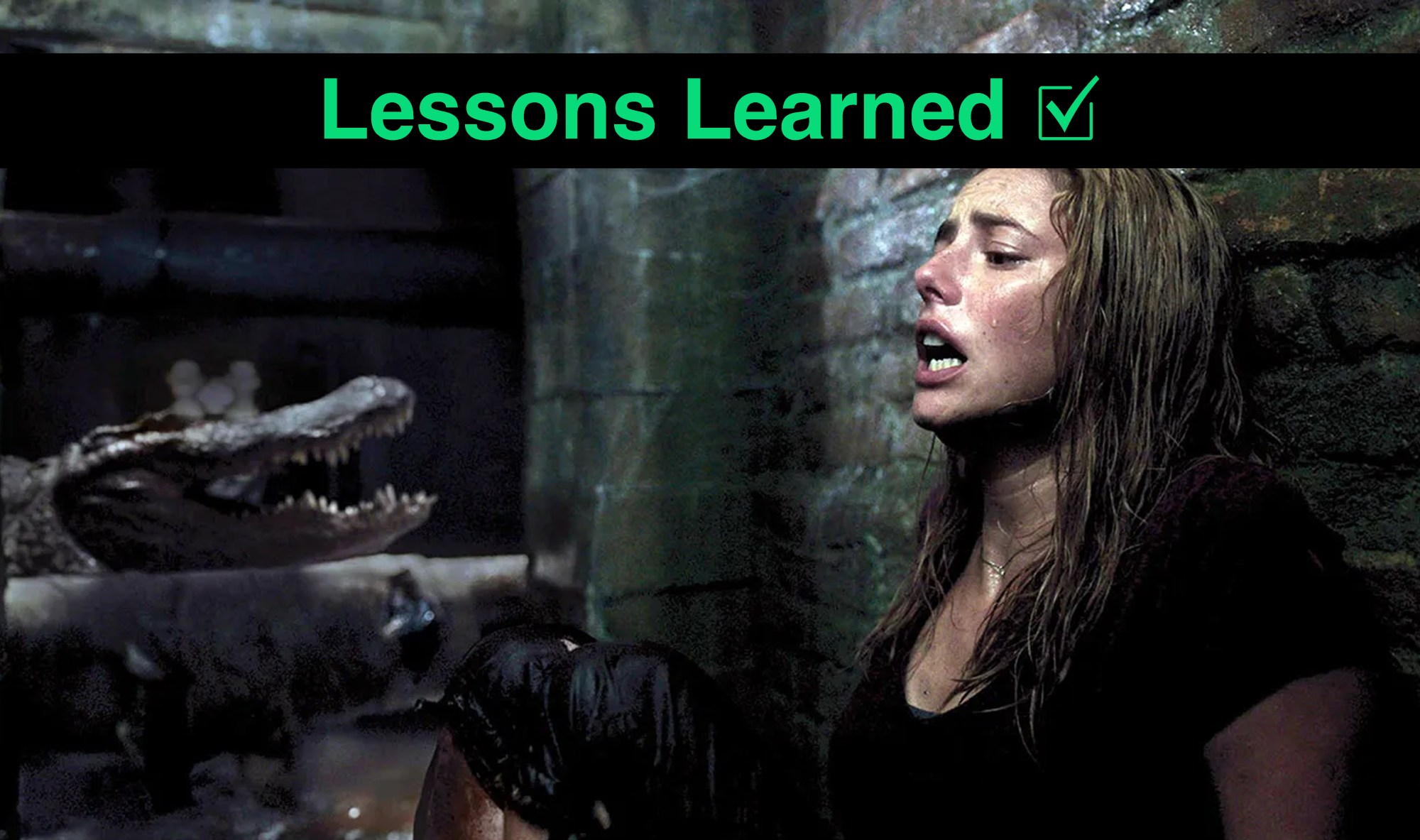
A young woman, while attempting to save her father during a category 5 hurricane, finds herself trapped in a flooding house and must fight for her life against alligators.
Crawl is a small, taut screenplay that was expanded in production, changing the third act of the film. In the original script, the story stays mostly in one location and moves fast, with every element pulling its weight. This is mean, lean storytelling from Michael Rasmussen and Shawn Rasmussen.
Here are three lessons I learned from reading the Crawl screenplay:
#1. GIVE STRONG REASONS FOR DIFFICULT CHOICES
On the following page of the Crawl screenplay, the protagonist (Haley) is searching for her Dad, who has not been answering his phone. After finding his truck parked outside a house he’s been working on, she investigates:
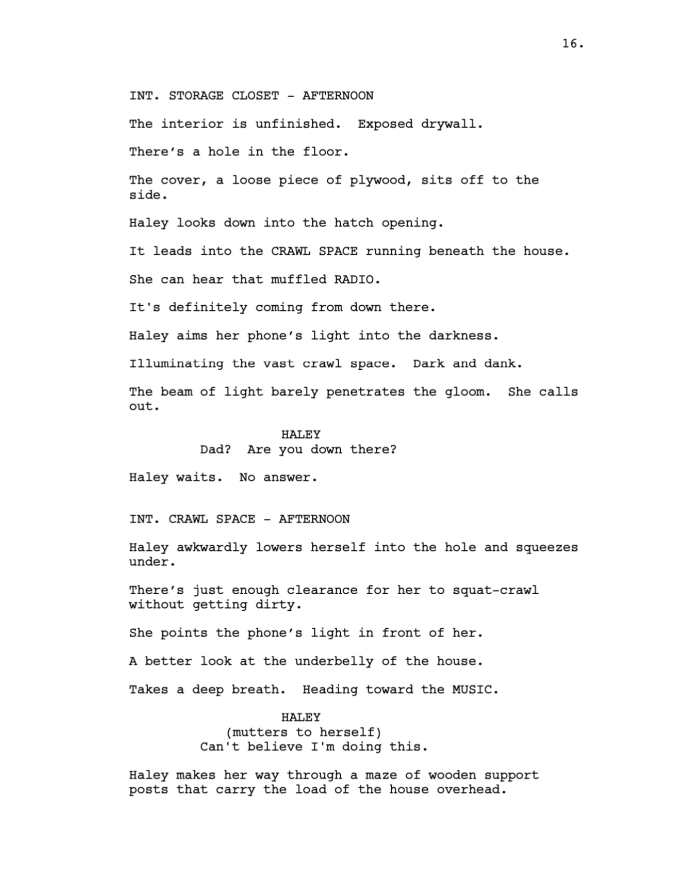
The premise of Crawl is simple, and our protagonist has strong reasons for making decisions that might make us throw popcorn at the screen if seen in a horror flick. What is more primal than protecting family? Interestingly, Haley and the creatures are both protecting family. On the screenplay page above, Haley “awkwardly lowers herself into the hole and squeezes under.” She’s entering a crawl space in a house she’s never been in.
Without those elements, this choice might’ve pushed me out of the story. But because of those elements, and Haley’s concern for her dad, the choice actually makes us like her more. She’s active. She’s making choices to keep her family safe.
The takeaway is simple: if a character makes a difficult choice, we need to understand why.
#2. BACK CHARACTERS INTO CORNERS, THEN SHOW THEM RESPOND ACTIVELY
At this point in the story, Haley and her Dad are trapped in the crawl space beneath the house, chased by a large, aggressive alligator. The following scene shows Haley hitting a dead end as the creature closes in:
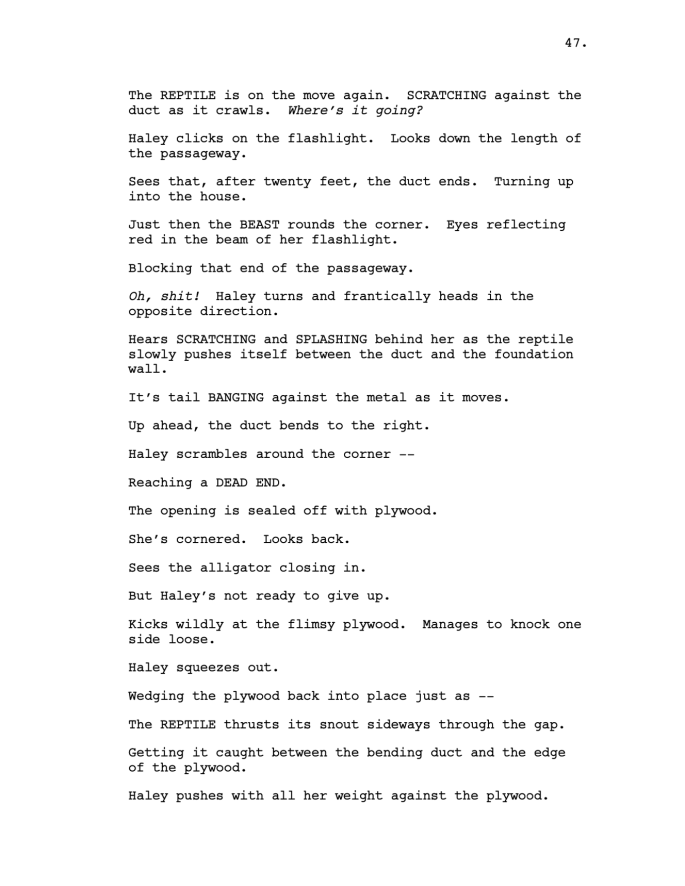
The Rasmussen Brothers keep both characters moving.
On the page above, Haley leaves a safe space where the alligator couldn’t reach her, but…
Just then, the BEAST rounds the corner. Eyes reflecting red in the beam of her flashlight.
Blocking that end of the passageway.
Haley flees, but when she comes to a dead end with the beast closing in behind her, she kicks her way through plywood and puts it back in place as “the REPTILE thrusts its snout sideways through the gap.”
Throughout the script, Haley is always moving, making choices that push her toward survival.
#3. HAVE FUN RAMPING UP SUSPENSE!
The following page of the screenplay is different in the final film, but I found it worth a look. Haley has climbed out of the crawl space, bitten and bleeding, and continues fighting with the female alligator:
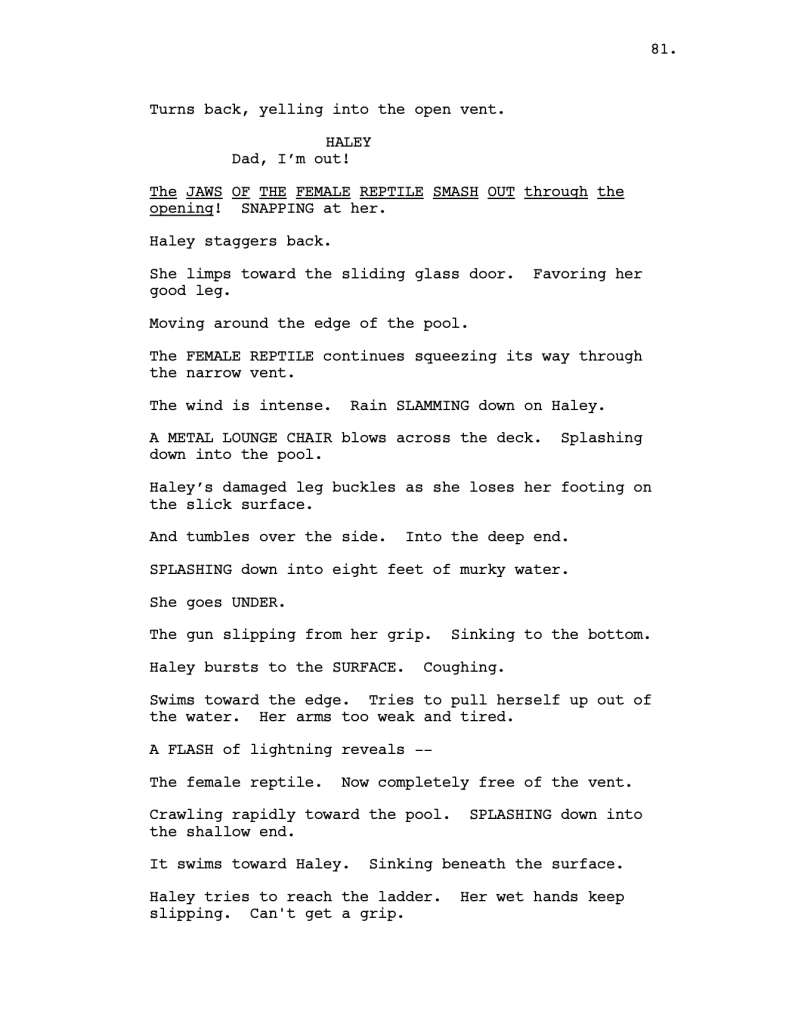
Haley has finally escaped the crawl space but the “FEMALE REPTILE” follows her into the backyard.
Haley is limping from a bite earlier and the Category 5 hurricane is in full effect — “A METAL LOUNGE CHAIR blows across the deck. Splashing down into the pool.” Then, Haley slips and falls into the pool! The pool, a major element of the climax, was established in the first act. As Haley struggles to get out of the water…
A FLASH of lightning reveals —
The female reptile. Now completely free of the vent.
Crawling rapidly toward the pool. SPLASHING down into the shallow end.
It swims toward Haley, sinking beneath the surface.
Now, this is one of my greatest fears. Ever since I was a child, I’ve had a fear of alligators and crocodiles and was plagued by recurring nightmares. This scene got under my skin. As I read, I was gripping my chair, wanting to know what would happen next. The scenes are easy to visualize and hard to put down.
The takeaway: have fun with the writing. Lean into the suspense. Get under the audience’s skin.


