

The story of King George VI, his unexpected ascension to the throne of the British Empire in 1936, and the speech therapist who helped the unsure monarch overcome his stammer.
The story behind The King’s Speech screenplay is extraordinary — much like its subject. David Seidler spent years researching and writing the script, then his wife suggested he write it as a stage play, so he changed course, and later returned to rewrite the play as a feature film. And he had to wait for the Queen to die before he was allowed to release the script, but he stuck with it due to his personal connection to the material, having overcome a stutter himself. We can learn from Seidler that persistence is key.
Here are three lessons learned from reading The King’s Speech screenplay:
#1. REVEAL MOMENTS OF PERSONAL CONNECTION.
The way characters interact and care for one another is essential to get audiences invested.

A lot is accomplished here: we see Bertie joke with his children (which gets the audience on his side), we see that he even struggles with the stutter in private moments (but that the lack of pressure causes it to subside), and we see his ability to tell a story.
When we see our heroes in private moments, living with integrity, treating others with kindness and love, we start to love them too. Add the complications of his speech impediment, and we root for him even more. The symbolism of the story — a penguin realizing “he could fly” — drives the whole point home.
Takeaway: Reinforce why characters do what they do, and make their dreams clear. When our heroes have something admirable to fight for, we are in their corner, listening with rapt attention.
#2. PUT YOUR CHARACTERS THROUGH HIGHS AND LOWS.
Everyone experiences highs and lows in life, and it is important to incorporate that into our storytelling.
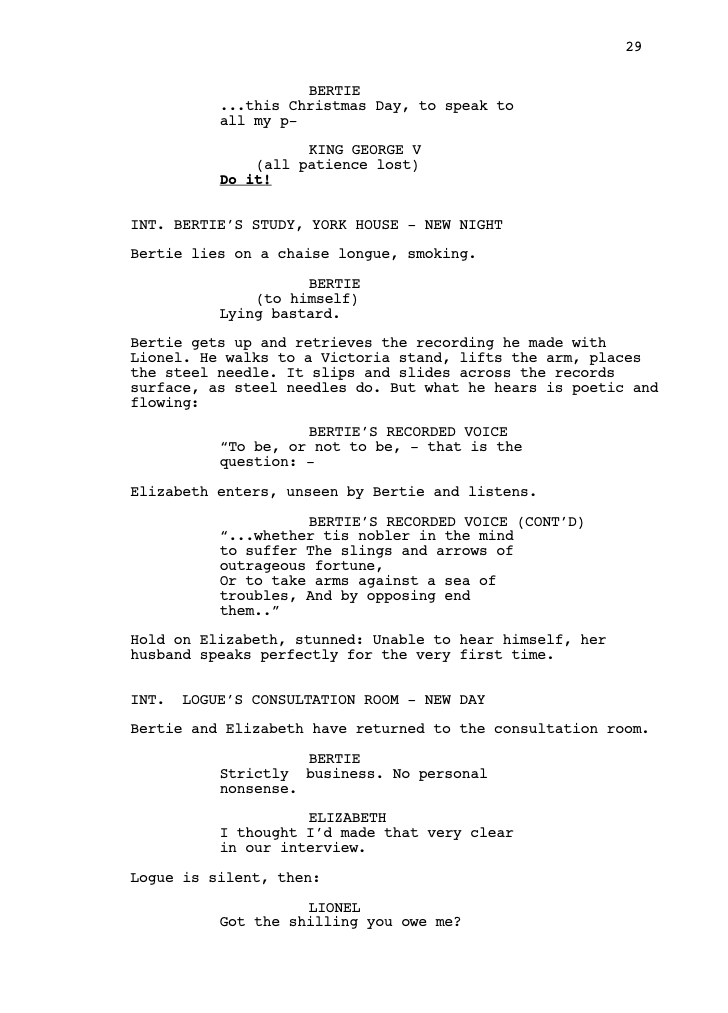
Just after being told to just “Do it!” by his father, Bertie angrily returns to his study and listens to the recording from earlier, when he had headphones on and could not hear himself. What does he find? Success. Something he had accomplished already but was too ignorant to notice or appreciate.
The addition of Elizabeth privately sharing this success through eavesdropping adds another layer of depth and complexity to the scene. The scene would have worked with him alone, certainly, but having her experience it with him was lovely and unexpected.
Takeaway: Put your characters through highs and lows while contextualizing scenes in interesting ways.
#3. KEEP YOUR PROTAGONIST HUMBLE.
“Luckily, I only had to repeat a few short oaths. I may not be so fortunate in the future.”
Bertie, The King’s Speech
Humility is an admirable trait, naturally. We like when characters speak of their success in a way that places it in a realistic context (not self-loathing or belittlement, but realistic), despite having to overcome massive hurdles in the process. We, as the audience, know their story and don’t need them to repeat it. They know that the journey has just begun.
Small moments like these make us lean in and think, “Is this character going to succeed?”
Bertie steps up to the plate with a humble, indomitable spirit, and we can’t help but root for him.

 Sean Taylor Creates