

When anti-mutant Colonel William Stryker kidnaps Professor X and attacks his school, the X-Men must ally with their archenemy Magneto to stop him.
X2: X-Men United is a film from my childhood that I vividly remember experiencing in theaters. With a script that evolved from other iterations to become its own thing, this is worthwhile reading for any screenwriter.
Here are three lessons I learned from reading the X2: X-Men United screenplay:
#1. OPEN WITH A BANG.
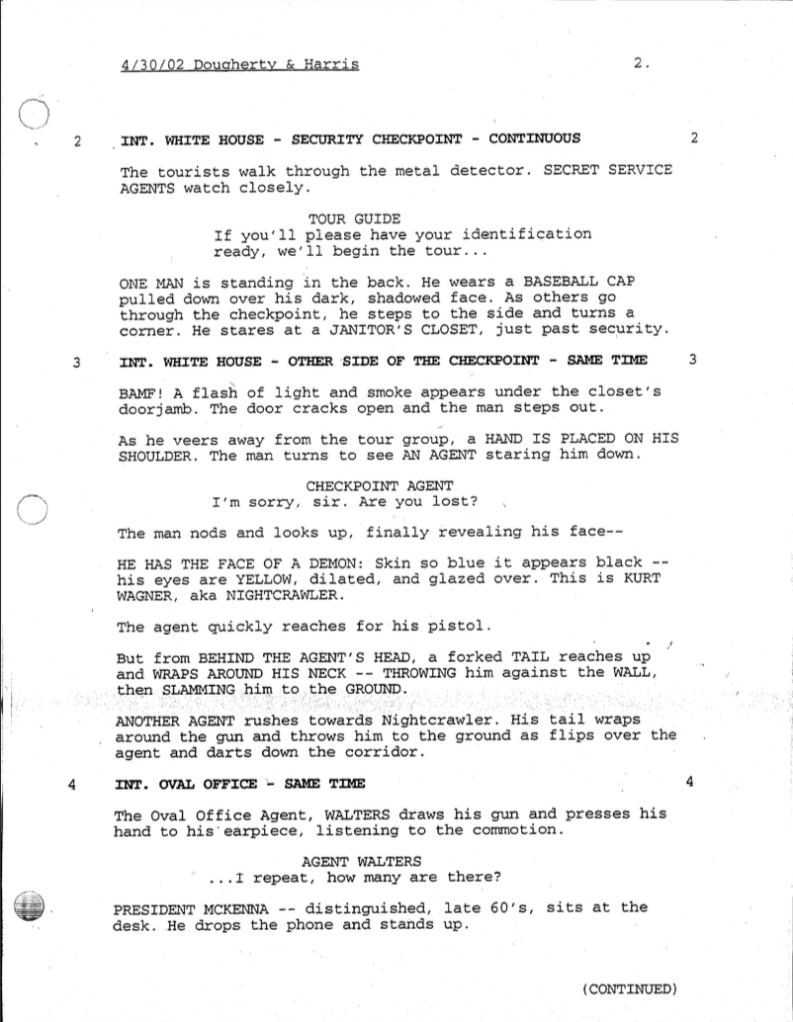
This is one of those cinematic scenes I experienced in theaters during my formative years that I will never forget. Nightcrawler (possessed, essentially), infiltrates the White House with panache in a phenomenally choreographed action sequence.
Every moment in this scene is tense. Every line carries weight. This is action that translates brilliantly to the screen.
As a viewer, and now writer, I learned that it is essential to open with a bang. Get your viewers hooked.
Whether it is film or television, viewers want something that gets them to stop that popcorn to mouth movement. As Marlon Brando put it, “When it’s right, you can feel it in your bones.”
#2. UTILIZE UNIQUE CHARACTER TRAITS TO REVEAL EXPOSITION.
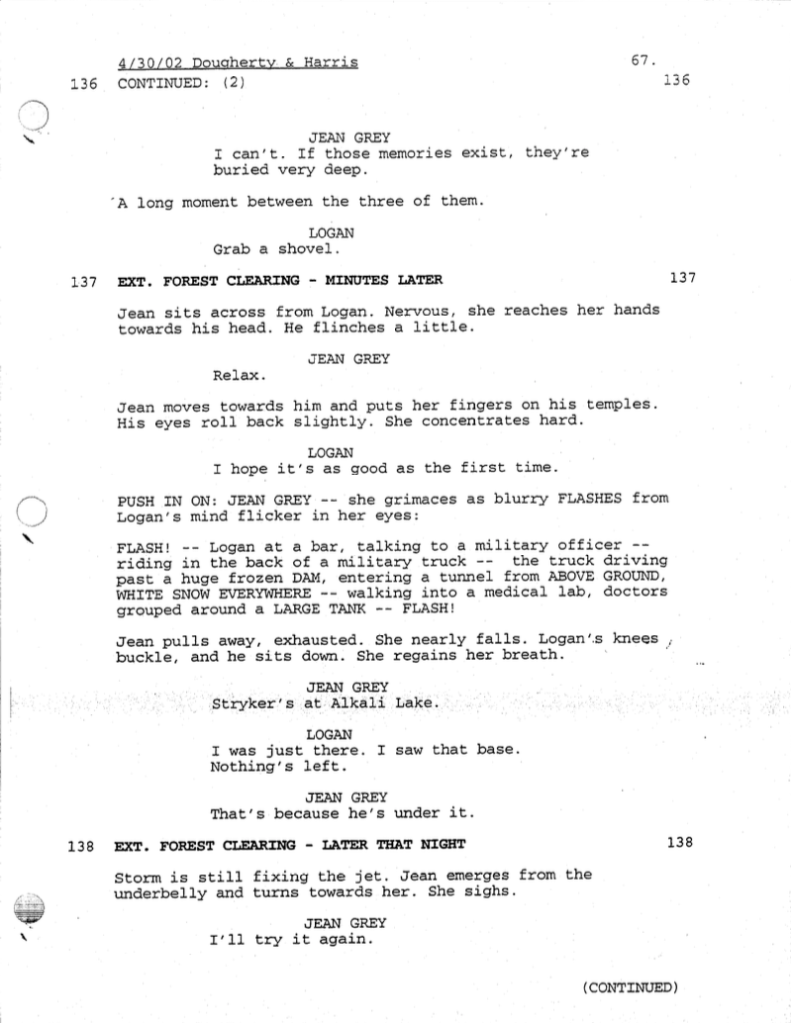
This is especially true here, where characters are easily identified by their mutant powers, but it translates to traditional drama and writing as well.
The exposition above could have easily been handled poorly, in a lesser writer’s hands. But instead, Jean Grey uses her powers to look into Logan’s memories, and the audience is shown what they need to see. Simple, sensible dialogue is used to clarify and move the scene along, while further establishing the character dynamics.
Well done.
#3. LET THE AUDIENCE FILL IN THE BLANKS.
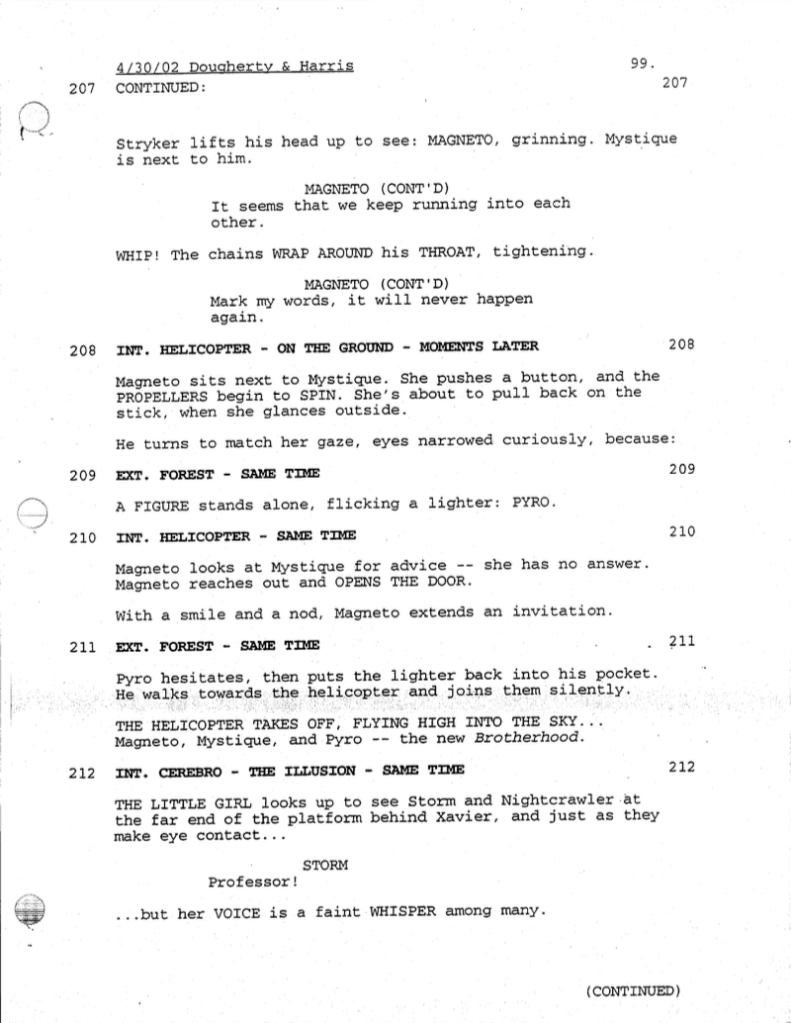
What a memorable moment. Magneto uses his powers to tighten the chains around Stryker’s neck, and he delivers the villainous line:
“Mark my words, it will never happen again.”
MAGNETO
Cutting away at that moment was highly intelligent, allowing the audience to fill in the gaps. Sometimes, violence onscreen fits the moment and mood, but here, it is perfect to infer the man’s fate, rather than show him choke and die. In my eyes, it is a classier way to write violence.
And then, Magneto and Mystique recruit a new member to their side, without any dialogue. An open door, a smile, and a nod. The audience gets it. They don’t need to be spoon-fed this addition to the team. An excellent example of “show, don’t tell.”

 Sean Taylor Creates