
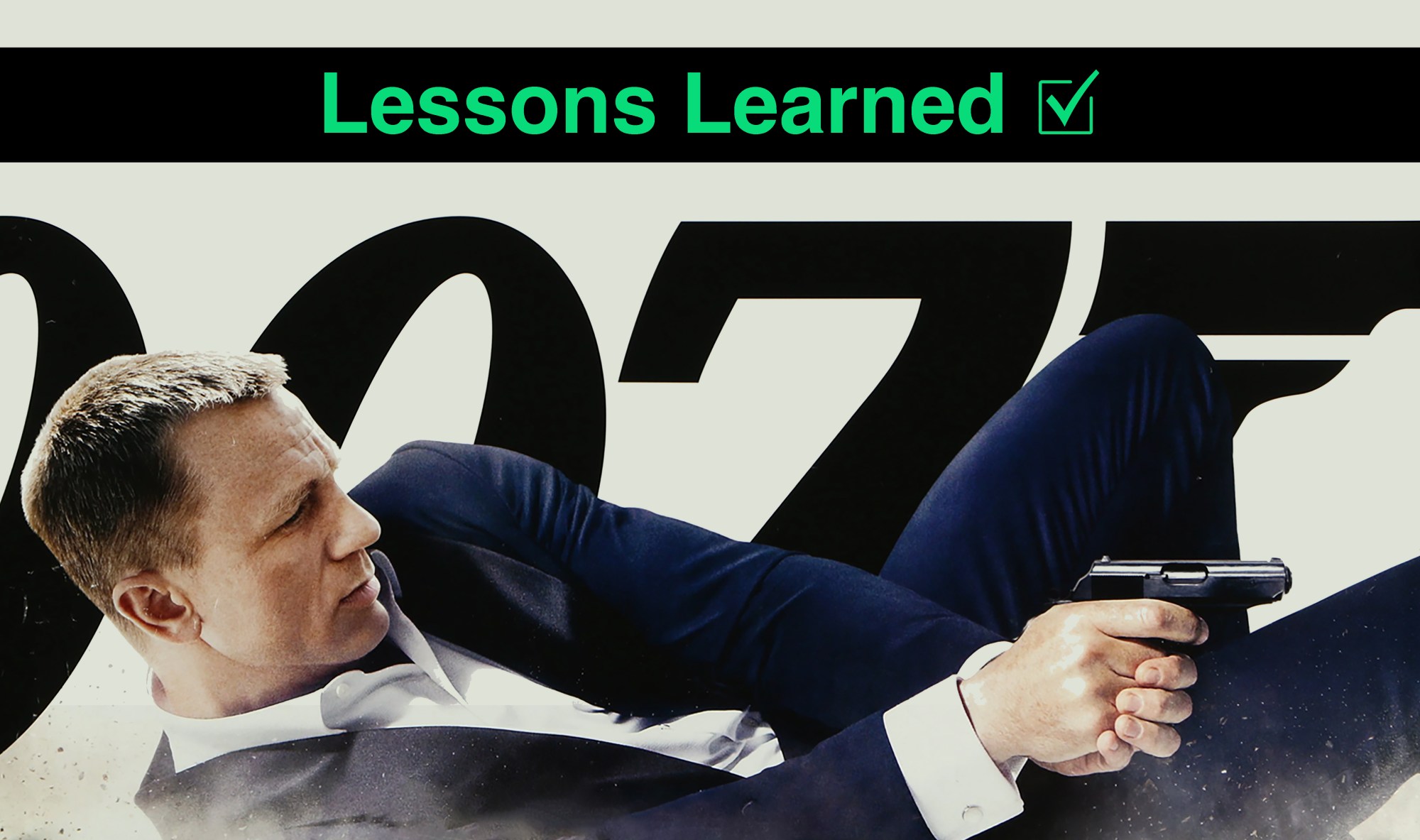
James Bond’s loyalty to M is tested when her past comes back to haunt her. When MI6 comes under attack, 007 must track down and destroy the threat, no matter how personal the cost.
The Skyfall screenplay by Neal Purvis, Robert Wade, & John Logan was different from what I expected. The action zips along, keeping the reader interested, and is worth a look.
Here are three lessons learned from reading the Skyfall screenplay:
#1. KEEP ACTION CONCISE. Action can be hard to write and ultimately comes down to style. Check out the first page of the Skyfall screenplay:

Now, I love this style, and even though I wouldn’t write it this way, it is strong and clear, drawing us into the story immediately. The spacing of the action is important, as it keeps the reader excited and turning pages.
Description here is sparse, giving us only what’s essential. The ability to paint a picture in readers’ heads, while allowing room for imagination, is that sweet spot we strive for as writers. It is not an easy feat, and there were moments in Skyfall when I felt I would have handled the wording and spacing differently, but damn is it effective.
By stripping down the action to its core elements, communicating with as little as possible, the screenplay has its readers hanging on every word.
#2. TWIST OLD-FASHIONED TROPES INTO THE NEW. This is especially effective in Skyfall due to the history of the IP and the need for an injection of fresh energy. Look at the following page, where Goldfinger is referenced, and an iconic Bond car is used to move the story forward:

Storytelling in film has come a long way over the last century, and now, with streaming, audiences are smarter than ever (at least, when it comes to film and TV). I’ve heard writers say, “Every story has been told! What is there to write?” To me, this is an absurd notion, and one tool I like to employ is twisting old-fashioned tropes into the new to make it fresh. This isn’t a trick or gimmick if done correctly.
Honor the past while blazing a new trail.
Skyfall excels in this beautifully. There are many throwbacks to older films, but they never feel forced or out of place. This is because the writers massage them in with care. They are used for the plot, rather than just being window dressing or unnecessary callbacks. Look at the reference to Goldfinger and the way the car is used throughout the final act of the film, before being destroyed.
Side note: This tool can absolutely be used incorrectly, in the form of unnecessary cameos or other foolishness we’ve seen on streaming lately. Don’t do that. Respect the past. Use it as a springboard, then put your unique twist on the story. Of course, keeping these elements grounded is essential; do not go so far as to make the story unbelievable or absurd.
#3. GIVE YOUR VILLAIN INTELLIGENCE, RESOURCES, AND THE UPPER HAND. Essentially, make your foe formidable. Yes, it’s basic, but it’s worth noting because the villain in Skyfall is so well-written, even when offscreen:
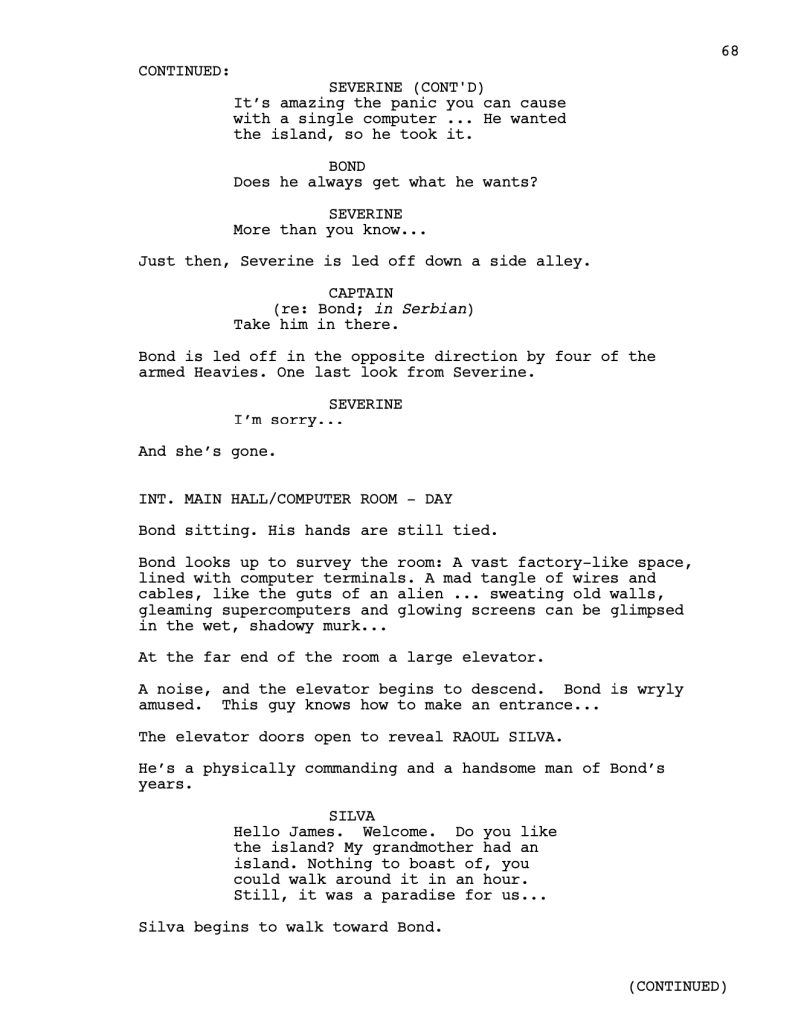
This is the first time the audience is seeing Silva in the flesh, and the writers inject Silva with a sense of theatricality, which they even note:
“A noise, and the elevator begins to descend. Bond is wryly amused. This guy knows how to make an entrance…”
What a great way to introduce the quirky villain. Silva is a formidable foe, and we know that he gets what he wants because, in this digital age, he knows how to hack any system and takes what he wants. Severine tells Bond a bit of backstory, saying that Silva wanted an island, so he faked a chemical outbreak and forced everyone to evacuate. His genius is in pulling strings from the darkness, and he is terrifying because anyone can become his puppet.
Silva uses his power to manipulate and destroy, and until the third act of the film, he remains one step ahead of Bond, M, and the rest of MI-6. It takes everything in Bond to face Silva, and this is why the stakes feel so high (beyond the initial setup, with names of undercover agents being released).
Silva’s delivery of the rat story is also flawless. The writing, directing, and acting were all incredibly effective. He tells a story about rats being trapped in a bucket and eating each other, until there were only two left. He describes himself and Bond as the last rats, and tries to convince Bond to turn on M. It’s a great little story to thread through and call back, as you’ll see with Bond’s one-liner upon killing Silva:
“Last. Rat. Standing”
James Bond
Silva is the yin to Bond’s yang. They were both M’s favorite, both brilliant agents. But Silva, upon feeling betrayed, decided to use his abilities to kill, destroy, and seize power, with no regard for human life. A truly psychopathic and terrifying villain. Well done.
 Sean Taylor Creates