
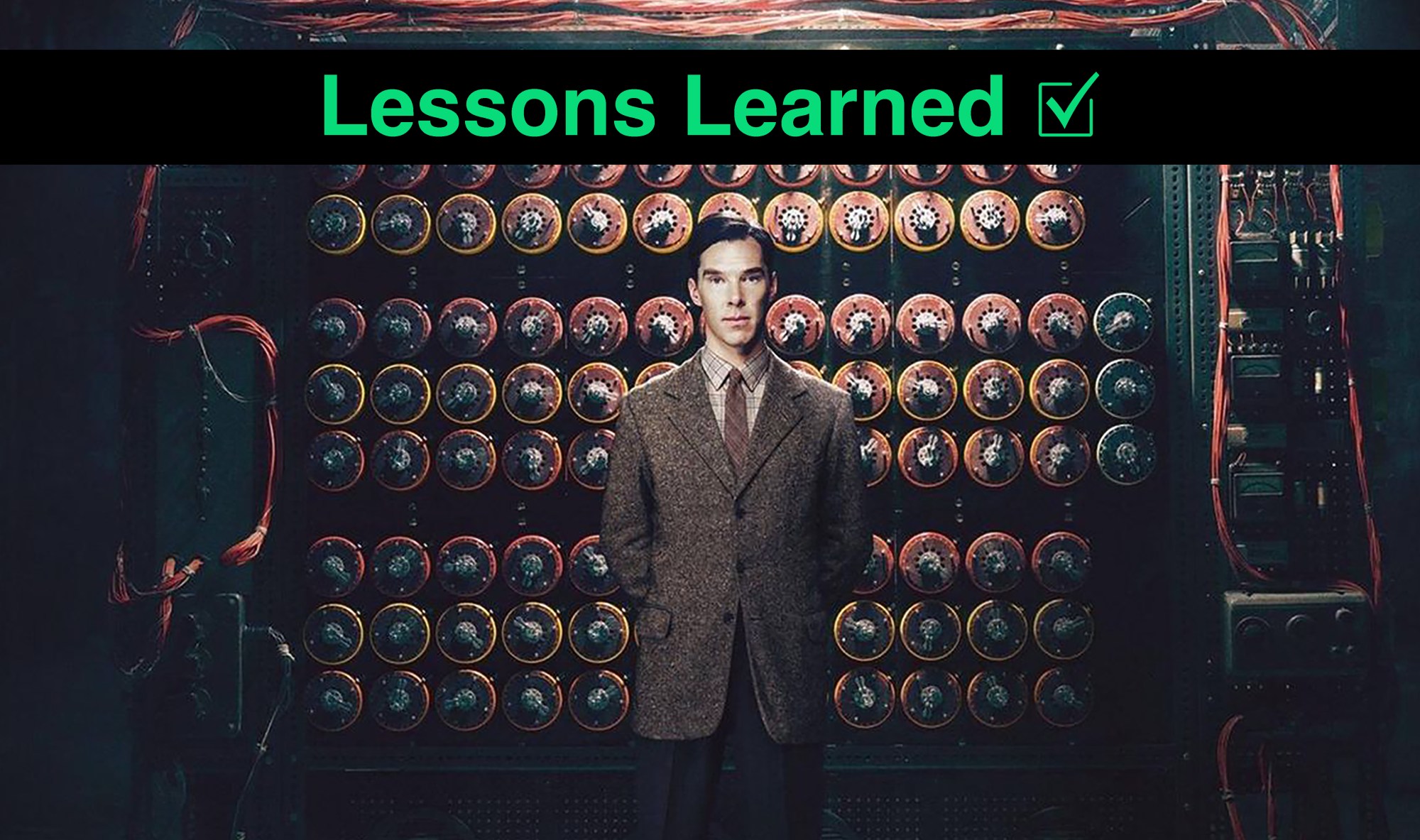
During World War II, the English mathematical genius Alan Turing tries to crack the German Enigma code with help from fellow mathematicians while attempting to come to terms with his troubled private life.
The Imitation Game is the Academy-Award winning film written by Graham Moore, adapted from the book Alan Turing: The Enigma by Andrew Hodges. The screenplay is brilliantly conceived and easy to read.
Here are three lessons learned from reading The Imitation Game screenplay:
#1. HOW TO REVEAL CHARACTER QUIRKS IN A FUNNY, LIKABLE MANNER. On the following page of The Imitation Game screenplay, Alan Turing’s social difficulties are on full display:
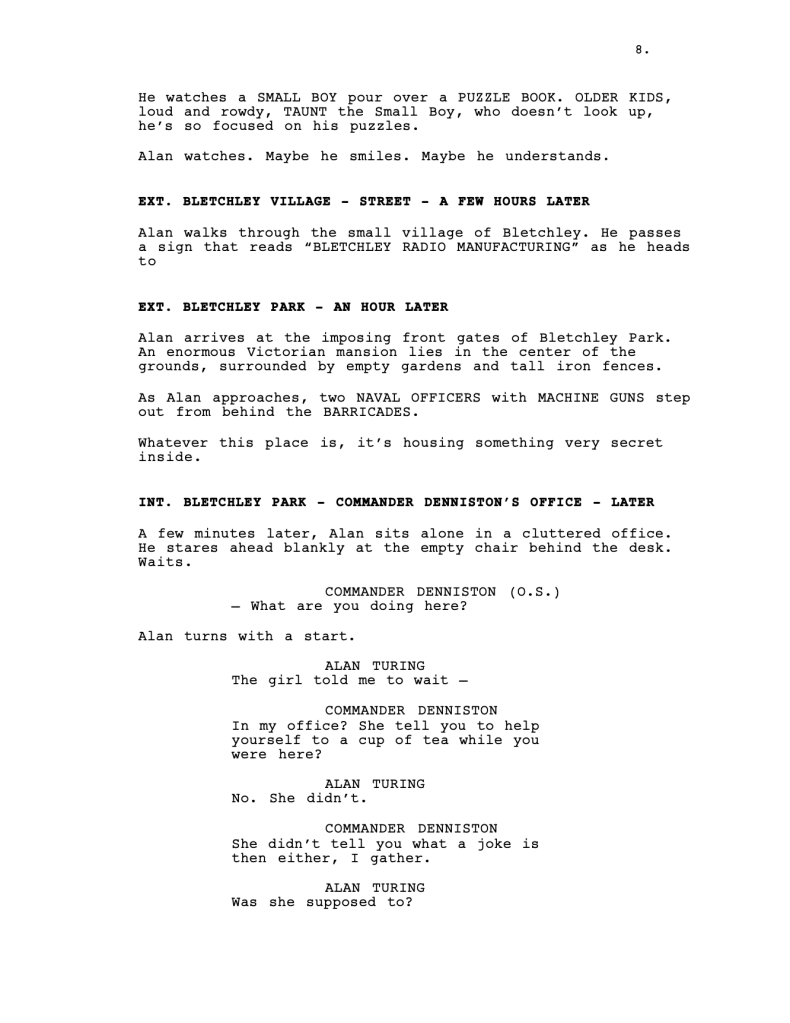
To be clear, Alan Turing’s family members stated after the film’s release that the man had many friends, a great sense of humor, and was socially adept, unlike how the film conveys him; creative license was taken by the screenwriter, an interesting choice that adds conflict. The character’s haughty nature is easier to swallow as an audience when we see that he wants to connect with others but does not understand how. Reading the screenplay and viewing the film, I enjoyed this aspect of his character and found it easier to empathize with him even in his most narcissistic moments. In just a few lines of dialogue, we get a sense of his character. Brilliantly done.
A similar moment later in the film is a flashback to Turing’s childhood when he discusses codes and cryptography with his best friend whom he is in love with — Christopher:
“When people talk to each other they never say what they mean, they say something else and you’re just supposed to know what they mean. Only, I never do.”
#2. HOW TO SHOW WHERE A CHARACTER’S HEART IS. On the following page of The Imitation Game screenplay, Alan and Joan discuss German messages and the machine he plans to build:
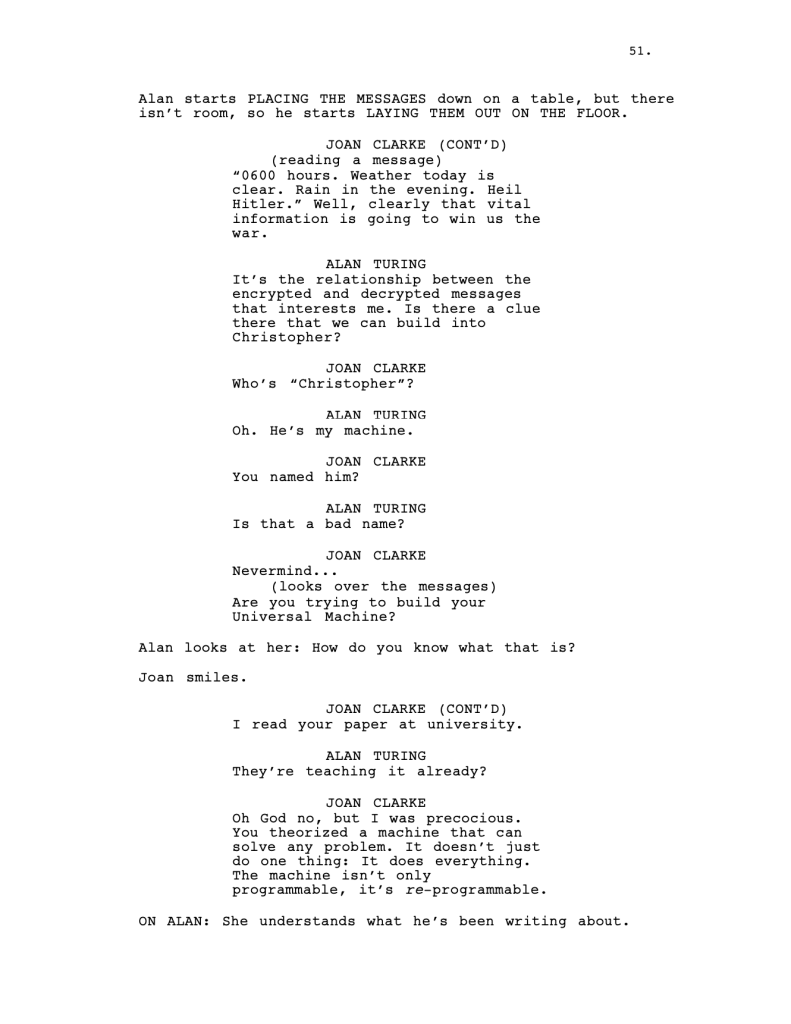
Another creative liberty is taken here; Alan Turing calls the machine “Christopher” when in reality the machine was titled “Victory.” Both great names but one reveals character and shows where Alan’s heart truly lies. Another fantastic choice by screenwriter Graham Moore.
The choice is strong yet subtle. Other characters do not know who Christopher is, but the audience is shown flashbacks revealing the intimate nature of their friendship. This creative choice accomplishes a great deal: it personalizes the machine, makes the audience want him to succeed even more because we want closure for him and his childhood love, and we are shown a deeply romantic, vulnerable side of a man who struggles to discuss his feelings.
#3. LEAD THE AUDIENCE TO INFORMATION. On the following page of The Imitation Game screenplay, the cryptography team has cracked Enigma (the German code) and discover one by one why Alan believes they must keep it a secret:
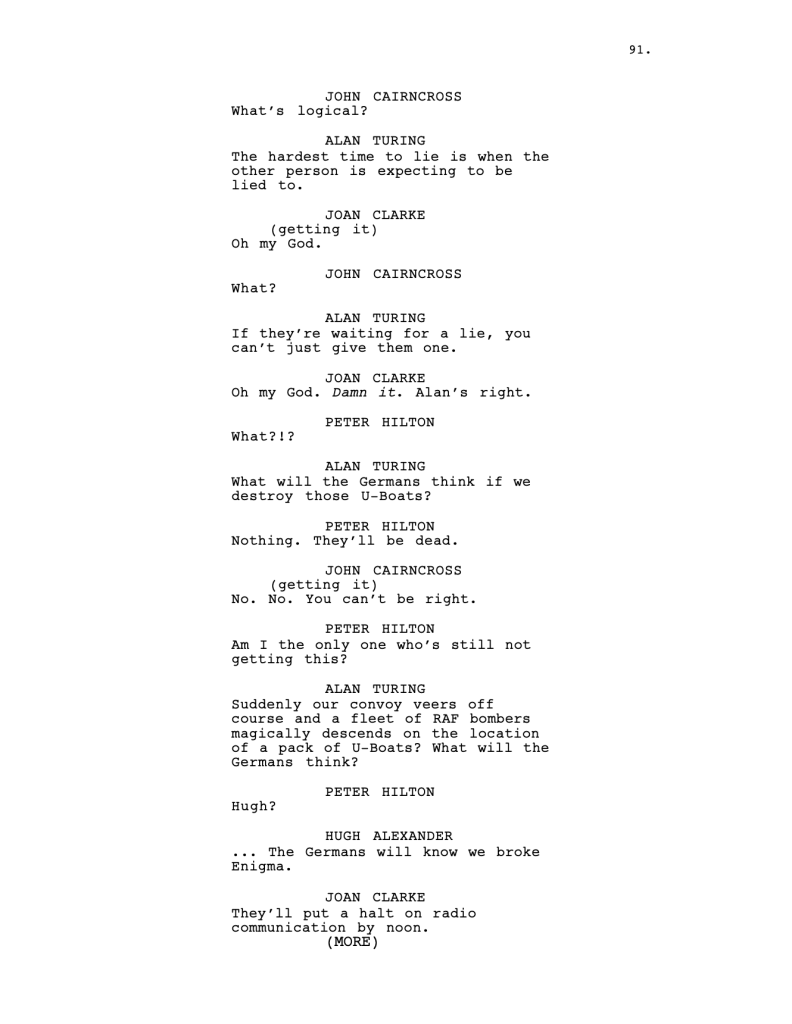
Naturally, Alan makes the realization first; he is a genius and the main protagonist. He explains his reasoning in a cryptic manner, fitting for the character and the scene, and one by one the others see his point of view. Peter even states, “Am I the only one who’s still not getting this?” which provides an in for viewers who still don’t understand. By writing the dialogue in this manner, Moore gives the audience time to catch up, to discover things alongside the brightest cryptography minds of the time. This can make viewers feel smart and invested on an intellectual level while regarding Turing as someone to listen to and respect.
Later in the scene, Peter states that his brother is on the convoy of ships that could be saved. This is another fictional creative liberty which works wonderfully because it adds conflict and involves the audience further by reaching them on an emotional level.
The Imitation Game is layered, intelligent screenwriting.

 Sean Taylor Creates
Excellent review of Alan Turing’s character. Christopher had a great influence on Alan and was never forgotten.