
After John Nash, a brilliant but asocial mathematician, accepts secret work in cryptography, his life takes a turn for the nightmarish.
It is fitting that Akiva Goldsman’s script for A Beautiful Mind be exceptionally beautiful itself. The 125-page screenplay (based on the biography by Sylvia Nassar) is complex, elegant, and powerful.
Here are 3 lessons I learned from reading the A Beautiful Mind screenplay:
#1. PERSPECTIVE WITH PURPOSE.

Page 11 is the first time that we see “NASH-POV” and thus the first time that we are visually exposed to his genius. Nash follows his intuition and creates a game out of “Go” called “Hex” which grows in popularity. The way that this scene is realized on the page is a thing to behold. Look at that last sentence —
Finally, he blinks, as if for the first time.
Wowza. Goldsman pulls us into Nash’s world, immerses us in its beauty, then displays the passing of time via a pre-written timelapse, and pulls Nash out, us along with him. A masterclass in playing the audience while simultaneously providing insight into the protagonist’s inner world.
From this page I learned the importance of impeccably choosing when and how to show a character’s perspective. In this scene, Nash is angry and stressed after a failure and uses the pain to rise stronger. This is the sign of a true winner. Use all failures as fuel.
#2. LEND REALISM TO THE FANTASTICAL. On the following page of the A Beautiful Mind screenplay, Nash talks with Parcher (spoiler alert) who is a delusion, a creation of Nash’s mind:
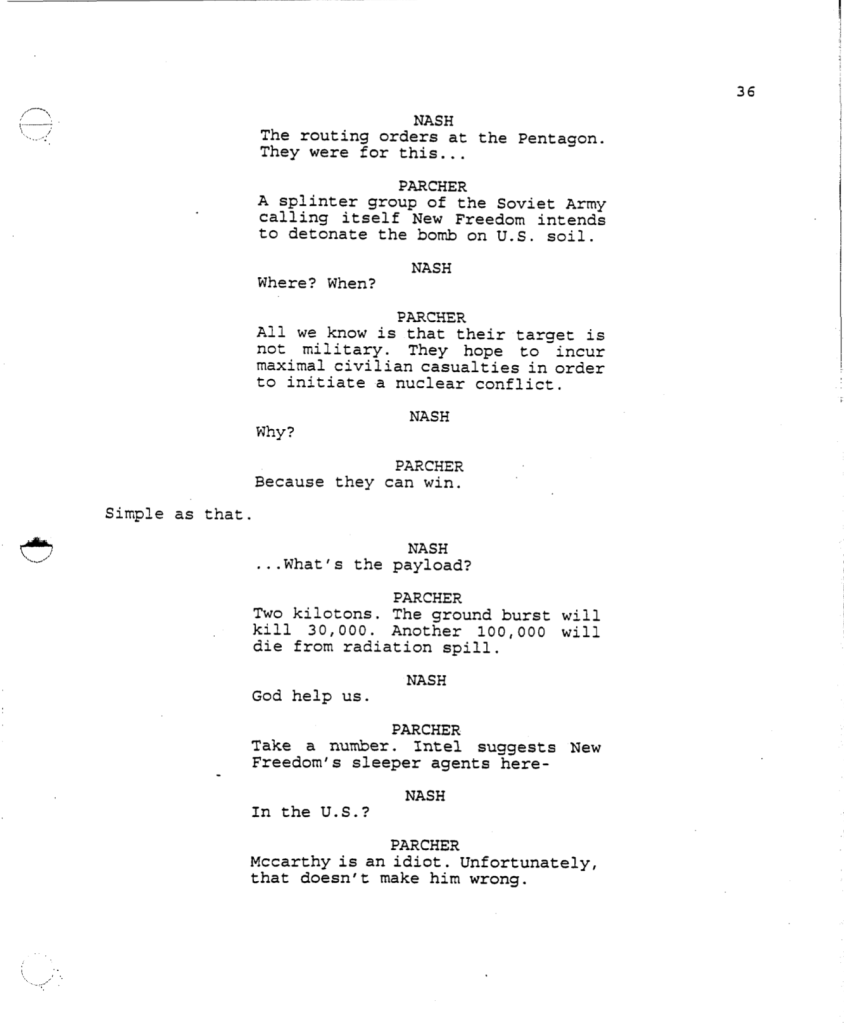
One of the many things that screenwriter Akiva Goldsman does well with this screenplay is making Nash and in turn, the audience, believe in these delusions. Parcher is real to us as we experience the film for the first time. The genius of this screenplay paired with Ron Howard’s powerful direction are a match made in heaven.
Howard took the material seriously and it shows. I also watched an interview with Akiva Goldsman and he discussed his motivations for seeking out the rights to the story before the book had even been published. Goldsman discussed his experience with people in his own life who “imagined things” which he saw as normal. Goldsman’s care for the characters is apparent from the beginning of the film and pervades throughout. Though some of the characters, like John Nash himself, may be brusque, they are still complex and lovable.
The only characters who lack authentic depth are the delusions but they still feel real on some level, if from afar. In the interview mentioned above, Goldsman talked about how he used a handsome, British guy liking Nash onscreen to help the audience like the eccentric character. Since the audience only sees these side characters in vignettes, it is hard to judge their true depth. And then, of course, Goldsman pulls the rug out from under us and reveals that no one else can see these characters.
Give all characters depth/layers but know when and how to exercise restraint.
#3. COMMIT TO PLAYING WITH THE AUDIENCE.

William Parcher, expertly played by Ed Harris, is very convincing. The stories he weaves for Nash are so complex and interesting that for a moment, perhaps, the audience doubts themselves, as Nash probably is feeling. Brilliant. The commitment to delusion is what really sells it. Look at how many lines are complete nonsense in reality but are delivered straight, as if it is a life-or-death scenario. These are the kinds of scenes that exhibit empathy from the viewer. We can experience what it might feel like to see delusions and how letting those go might be difficult. Nash feels important in this world he has created for himself.
Immersive storytelling. Nice work, Goldsman.

 Sean Taylor Creates